Feeds:
Posts
Comments

Posts Tagged ‘Economics’

I have to start this post with a big caveat.

OECD bureaucrats get tax-free salaries but urge higher taxes for everyone else

I’m not a fan of the Paris-based Organization for Economic Cooperation and Development. The international bureaucracy is infamous for using American tax dollars to promote a statist economic agenda.

Most recently, it launched a new scheme to raise the tax burden on multinational companies, which is really just a backdoor way of saying that the OECD (and the high-tax nations that it represents) wants higher taxes on workers, consumers, and shareholders.

But the OECD’s anti-market agenda goes much deeper.

Now that there’s no ambiguity about my overall position, I can admit that the OECD isn’t always on the wrong side. Much of the bad policy comes from its committee system, which brings together bureaucrats from member nations.

The OECD also has an economics department, and they sometimes produce good work. Most recently, they produced a report on the Swiss tax system that contains some very sound analysis – including a rejection of Obama-style class warfare and a call to lower income tax burdens.

Shifting the taxation of income to the taxation of consumption may be beneficial for boosting economic activity (Johansson et al., 2008 provide evidence across OECD economies). These benefits may be bigger if personal income taxes are lowered rather than social security contributions, because personal income tax also discourages entrepreneurial activity and investment more broadly.

I somewhat disagree with the assertion that payroll taxes do more damage than VAT taxes. They both drive a wedge between pre-tax income and post-tax consumption.

But the point about income taxes is right on the mark.

Interestingly, the report also endorses tax competition as a means of restraining the burden of government spending.

Evidence also suggests that tax autonomy may lead to a smaller and more efficient public sector, helping to limit the tax burden and improve tax compliance… Efficiency-raising effects of tax autonomy and tax competition on the public sector have also been reported in empirical research with Norwegian and German data… Tax autonomy generates opportunities to choose the level of public service provision and taxation, although in practice such “voting with your feet” seems mostly limited to young, highly educated and high-income households. Decentralised tax setting also fosters benchmarking of the performance of jurisdictions belonging to the same government level by voters, even in the absence of “voting with your feet”.

The report also notes that tax competition has reduced corporate tax rates.

Tax competition is likely to have contributed significantly to lowering corporate tax rates in Switzerland over the past 25 years. Indeed, empirical evidence shows that the responsiveness of sub-national governments to tax changes of other subnational governments (“tax mimicking”) is the strongest in the case of corporate taxation (Blöchliger and Pinero Campos, 2011). …Progressive corporate income taxes harm incentives for businesses to grow. Since growing businesses are likely to be high performers in terms of productivity, such disincentives are likely to hit high-performing businesses the most, with losses to aggregate productivity performance, which has been modest in Switzerland relative to best-performing high-income countries.

P.S. This isn’t the first time the economists at the OECD have broken ranks with the political hacks that generally control the bureaucracy. In a 1998 Economic Outlook (see page 166), they wrote that “the ability to choose the location of economic activity offsets shortcomings in government budgeting processes, limiting a tendency to spend and tax excessively.”

And in another publication (see page 1), the economists noted that “legal tax avoidance can be reduced by closing loopholes and illegal tax evasion can be contained by better enforcement of tax codes. But the root of the problem appears in many cases to be high tax rates.”

These passages sound like they could have been authored by Pierre Bessard!

P.P.S. I hasten to add that none of this justifies handouts from American taxpayers to the Paris-based bureaucracy any more than occasional bits of rationality from the World Bank (on government spending), IMF (on the Laffer Curve), or United Nations (also on the Laffer Curve) justify subsidies to those organizations.

Read Full Post »

The main goal of fiscal policy should be to shrink the burden of government spending as a share of economic output. Fortunately, it shouldn’t be too difficult to achieve this modest goal. All that’s required is to make sure the private sector grows faster than the government.

But it’s very easy for me to bluster about “all that’s required” to satisfy this Golden Rule. It’s much harder to convince politicians to be frugal. Yes, it happened during the Reagan and Clinton years, and there also have been multi-year periods of spending discipline in nations such as Estonia, New Zealand and Canada.

But these examples of good fiscal policy are infrequent. And even when they do happen, the progress often is reversed when a new crop of politicians take power. Federal spending has jumped to about 23 percent of GDP under Bush and Obama, for instance, after falling to 18.2 percent of economic output at the end of the Clinton years.

This is why many advocates of limited government argue that some sort of external force is needed to somehow limit the tendency of politicians to over-tax and over-spend.

I’ve argued on many occasions that tax competition is an important mechanism for restraining the greed of the political class. But even in my most optimistic moments, I realize that it’s a necessary but not sufficient condition.

Another option is budget process reform. If you can somehow convince politicians to tie their own hands (in the same way that alcoholics can sometimes be convinced to throw out all their booze), then perhaps rules can be imposed that improve fiscal policy.

But what sort of rules? Europe has “Maastricht” requirements that theoretically limit deficits and debt, and 49 states have some sort of balanced budget requirement, but these policies have been very unsuccessful – perhaps because they mistakenly focus on the symptom of red ink rather than the underlying disease of government spending.

Are there any budget process reforms that do work? Well, I’ve written about Switzerland’s “debt brake,” which has generated some good results over the past 10 years because it actually imposes an annual spending cap.

Some American states also impose expenditure limits. Have they been successful?

Unfortunately, they usually don’t seem to do a good job of controlling spending. Here are some key passages from a new study by Benjamin Zycher from the American Enterprise Institute.

…tax and expenditure limits (TELs) vary substantially in terms of their details, definitions, and underlying structures, but the empirical finding reported here is simple and powerful: TELs are not effective. …The ineffectiveness of TELs is unambiguous in terms of summary statistics, case-study examination of the records of several individual states, and estimation of an econometric model. This model was estimated for both state and local spending combined and state outlays considered alone.

The author finds some positive impact, but it’s unclear whether the results are meaningful…or durable.

In terms of the growth rates of per capita outlays, 20 of the 30 states display a decline in that growth rate during the periods when the respective TELs were effective, but none of those differences is statistically significant. …to the (highly limited) extent that spending limits prove effective, they are likely to be subject to erosion driven by the same political factors that yield the fiscal pressures.

Though three states seem to have generated genuine budgetary savings.

Among the 30 states with TELs in effect during 1970–2010, the econometric analysis finds that only three of those limits had the effect of reducing total outlays, by approximately 4–6.5 percent. This evidence does not provide grounds for optimism that an emphasis on spending limits would prove useful in terms of reducing long-term fiscal pressures.

Looking at all the evidence, Zycher is not very optimistic about expenditure limits, though he does recognize the valuable role of tax competition.

…a TEL is unlikely by itself to reverse the underlying conditions that yield expanding government. In particular, the incentives of interest groups to circumvent and neutralize the effects of TELs are unsurprising; that may be one central lesson from the California and Washington experiences. Future efforts to restrain the growth in government spending may find greater success if they are directed at increasing competition… One obvious way to achieve this is to strengthen the institutions of federalism, thus forcing states and localities to compete with each other.

Other researchers also have looked at tax and expenditure limits, so let’s see whether they have different perspectives.

Matt Mitchell (no relation) has a slightly more optimistic assessment. Here’s some of what he wrote in a study for the Mercatus Center.

…some varieties of TELs can decrease state spending as a share of state income, but the effect is small—in the range of about 2 to 3 percent. …Certain characteristics can make TELs more effective. These include constitutional (as opposed to statutory) codification, a focus on spending rather than on revenue, a provision that automatically and immediately refunds surpluses, and—of particular importance—a provision that requires either a supermajority vote or a public vote for override.

Here are some of his specific findings.

Weak TELs…tend not to impact state spending very much in either low or high-income states. At best, they decrease spending by about 1/10 of one percentage point in low-income states. At worst, they increase spending by less than 1/100 of one percentage point in high-income states. The most-stringent TELs, on the other hand, do have an appreciable impact on state spending. …Those TELs that limit budgets to inflation plus population growth seem to limit combined state and local spending. In states with this variety of TEL, state and local spending as a share of state income is about 6/10 of a percentage point less than in other states (this is a 3-percent difference relative to the average state and local spending share). …This variety of TEL is often favored by advocates of limited government because it is particularly restrictive (the sum of inflation and population growth is typically less than income growth).

Michael New of the University of Michigan-Dearborn also found that the design of a TEL makes a big difference. Here are some excerpts from his study, which was published in the State Politics and Policy Quarterly.

…most TELs have been enacted by state legislatures, and it is not clear that legislators have the incentive to reduce their autonomy by placing meaningful constraints on their own behavior. …Conversely, TELs enacted through citizen initiatives are likely to be drafted by interest groups that actually possess an interest in limiting state spending, giving them considerably greater potential for effectiveness.

Here are some of his results.

Why has Colorado’s TABOR been more effective than other fiscal limits? …the results of Models 2 and 4, which categorize TELs based on how they were adopted, lend considerable support to my hypothesis. These models indicate that TELs enacted by citizen initiative are the most effective at limiting the size of government. Model 2 predicts that after a TEL is passed by a citizen initiative, annual growth in per capita state and local expenditures will be reduced by $35.70. Similarly, Model 4 predicts that the annual growth in per capita state and local revenues will be reduced by $35.64. Both findings are statistically significant.

Professor New’s research shows that it is very important to limit spending so it grows at inflation plus population rather than letting it climb as fast as personal income.

…holding increases in expenditures to increases in personal income is a relatively easy threshold for a state to maintain. …During the early 1990s, however, two states enacted TELs with a lower limit. Both Colorado’s Taxpayer’s Bill of Rights (TABOR) and Washington state’s Initiative 601 (I-601) established a limit of inflation plus population growth. …Table 4 provides further evidence that strong TELs have been able to restrict government growth. Holding other factors constant, strong TELs annually reduce growth in both state expenditures and state revenues by over $100 per capita. …Both the coefficient for TABOR and the coefficient for I-601 are negative in all four regressions and statistically significant in three of the four. …My analysis provided solid evidence that these two TELs were even more effective at restraining expenditures and revenues as demonstrated by both statistical analysis and case studies.

Some people would conclude from the research of Zycher, Mitchell, and New that spending limits are not very effective. But that’s a hasty conclusion. The real lesson is that spending limits work, but only if they actually limit spending so that it grows slower than personal income, just as suggested by my Golden Rule.

In other words, spending limits are like speed limits in school zones. They are only effective if they’re set low enough to actually protect taxpayers and children.

This debate reminds me of the intellectual fight over the starve-the-beast hypothesis. Some have argued that tax cuts are not an effective way of limiting spending. But the research actually shows that tax cuts are an effective way of “starving the beast” if lawmakers don’t subsequently raise taxes.

The bottom line is that expenditure limits – if properly designed and enforced – are an effective way of controlling government spending. That doesn’t mean that politicians won’t figure out ways to over-spend, just like locks on doors don’t always stop burglars. But both are better than the alternative of no limits or no locks.

In prior posts, I’ve shared research showing that the United States today would be very close to a balanced budget if we had implemented something akin to the Swiss Debt Brake.

So far as I know, there’s no legislation to impose a spending cap specifically modeled on the Swiss system, but I’ve previously noted that Senator Corker’s CAP Act and Congressman Brady’s MAP Act both have sequester-enforced spending limits.

And the good news about sequestration is that the savings are real, unlike the gimmicks that you get when the politicians are in charge of “cutting” spending.

Read Full Post »

I’ve written many times about how investors, entrepreneurs, small business owners and other successful people migrate from high-tax states to low-tax states.

Well, the same thing happens internationally, as France’s greedy politicians are now learning.

It’s a lot harder for Americans to escape our tax system, though, in part because of reprehensible exit taxes that are disturbingly reminiscent of some of the awful policies of past totalitarian regimes.

But it still happens, and that’s a very damning indictment of Obamanomics and a worrying referendum on the future of the United States. Here are some blurbs from a recent Fortune article.

Americans are ditching their U.S. passports in record numbers, a sign of growing frustration with a system that taxes U.S. citizens on their global wealth whether they live in Montana or Mongolia. …on the list, published quarterly by the Internal Revenue Service, is Isabel Getty, the daughter of jet-setting socialite Pia Getty and Getty oil heir Christopher Getty. In total, more than 670 U.S. passport holders gave up their citizenship — and with it, their U.S. tax bills — in the first three months of this year. That is the most in any quarter since the I.R.S. began publishing figures in 1998. And it is nearly three-quarters of the total number for all of 2012, a year in which the wealthy songwriter-socialite Denise Rich (christened “Lady Gatsby” by Yachting magazine) and Facebook co-founder Eduardo Saverin joined more than 932 other Americans in tossing their passports. …Expatriations first picked up pace in 2010, when more than 1,530 Americans dumped their passports.

The problem is particularly serious for Americans who live and work overseas. The United States is one of the few nations (and the only developed nation) to have “worldwide” taxation, which means overseas Americans have to pay tax to the IRS as well as to the nation where they live.

And thanks to laws such as “FATCA,” that burden just became far more onerous.

While dumping citizenship may seem unpatriotic or smack of tax avoidance to some critics, tax lawyers blame the byzantine complexity of American tax regulations. The rules “are confusing, complex, and so complicated that even Americans with good intentions can easily find themselves running afoul of the law,” said Jeffrey Neiman, a former federal prosecutor who was involved in the government’s offshore banking probe and is now in private practice in Fort Lauderdale, Fla. “This very well may explain why we are seeing a record number of Americans renouncing their United States citizenship.”

No wonder more and more people are escaping Obamanomics.

The good news, by the way, is that Senator Rand Paul has introduced legislation to repeal the worst parts of FATCA.

But that’s not going to happen while Obama’s still in the White House, so let’s focus on the Americans who are “going Galt.”

I have mixed feelings about these rich people. Many of them did nothing to help the fight for liberty while they were U.S. citizens.

And notwithstanding my post about where I would go if America suffers a Greek-style fiscal collapse, I suspect I’ll stay in the United States and fight until my last breath. So I get a little bit irked that they escape and leave the rest of us to deal with the mess created by our political elite.

Nonetheless, I strongly believe that all individuals have the right to protect themselves from predatory government.

And when you add up the various forms of double taxation in the internal revenue code (particularly the death tax), it makes little sense for families with high net worth to stay in the United States when there are many jurisdictions around the world that will welcome them with open arms.

In other words, let’s not blame the victims and castigate Americans who redomicile in jurisdictions with better tax policy. Let’s fix the awful internal revenue code with a flat tax.

P.S. I’m ashamed to admit that France has a more pro-liberty policy on tax migration than the United States.

P.P.S. But that may not last too long. Other nations are looking to copy America’s disgraceful worldwide tax approach.

Read Full Post »

I’ve written before about the remarkable vitality of Hong Kong and Singapore, two jurisdictions that deserve praise for small government and free markets.

Monaco T

Pretending to be a jet-setter in Monaco

I have also praised Switzerland because of policies such as genuine federalism and financial privacy, and it goes without saying that I admire tax havens such as Bermuda, Monaco, and the Cayman Islands

I’m a big fan of Estonia, which has made big strides thanks to the flat tax and other free market reforms.

Australia also is one of my favorite nations, in part because of its privatized Social Security system.

Even Canada and Sweden have earned my praise for recent economic reforms.

But here’s a video, produced by the folks at The Fund for American Studies, that identifies an even more impressive economic miracle.

I did guess the country in the video, but only a few seconds before the narrator spilled the beans. My excuse is that I watched early on Sunday morning, when civilized people should still be asleep.

But allow me to atone for my slowness by adding a very important point about growth. The country in the video became successful because it enjoyed a very long period of decent growth. But that has recently changed for the worse.

And things got worse when statists were in power, as even the Washington Post has acknowledged.

The lesson to be learned is that even small differences in growth can make a big difference over time.

By some measures, Hong Kong and Singapore are now richer than the United States. The simple reason is that those jurisdictions have been enjoying 5 percent-plus growth for decades while the United States economy has struggled to achieve 3 percent growth.

Then again, the United States is more prosperous than most European nations, though that may be an example of damning with faint praise.

Read Full Post »

I can say with great confidence that government bureaucrats are overpaid compared to people in the productive sector of the economy.

Why am I sure that this is true, particularly when the so-called Federal Salary Council claims bureaucrats are underpaid?

For the simple reason that the “job opening and labor turnover” data from the Department of Labor is the best way to measure whether a group of workers is overpaid or underpaid.

And you probably won’t be surprised to learn from this data that bureaucrats at the federal, state, and local level are only about 1/3rd as likely to quit their jobs as workers in the private sector.

They’re less likely to leave their jobs, needless to say, because they generally get paid more than they’re worth.

But just in case you think this data is unconvincing, let’s look at some additional research.

Sita Slavov of the American Enterprise Institute explores this topic in an article for U.S. News & World Report.

…studies show that, while the salaries of public sector workers are roughly in line with those paid in the private sector, public sector workers receive substantially more generous fringe benefits, such as pensions, health benefits, vacation and job security. …Why are public sector workers so highly compensated? And, why is their compensation so heavy on benefits? Workers certainly value benefits, such as access to group health insurance, and many benefits are tax advantaged. But do public sector workers really value these benefits more than private sector workers? Edward Glaeser and Giacomo Ponzetto have attempted to address these questions in a recent National Bureau of Economic Research working paper entitled “Shrouded Costs of Government: The Political Economy of State and Local Public Pensions.” The authors present a formal model in which public sector compensation is determined by a political process that pits politicians against each other in a competition for votes. They show that this political process results in a public sector compensation package with generous benefits.

In other words, bureaucrats are over-compensated, and much of their excess compensation is in the form of generous fringe benefits.

The new study cited by Sita looks at why this happens.

Public sector workers have an information advantage over other voters. In particular, they are better informed about their own compensation packages. Moreover, this information advantage is more pronounced for benefits than salary. This is plausible because information about public sector salaries is available to the general public… In contrast, information about public sector pensions is less widely available, and because of complications involved in valuing future pension benefit promises, it is also more difficult to interpret. As a result, politicians propose generous public sector compensation that is tilted towards benefits rather than salary. A politician who tries to scale back public sector benefits will lose support from public sector voters (who are hurt by the benefit cut) without gaining much support from other voters (who gain from lower taxes but are poorly informed).

My interpretation of these findings is that politicians and bureaucrats basically conspire to rip off taxpayers.

In exchange for campaign contributions and other forms of political support, the politicians give the bureaucrats excessive compensation. But they make it difficult for taxpayers to figure out how they’re getting robbed by concentrating a big share of the excess in harder-to-measure fringe benefits.

Another advantage of that approach, by the way, is that the bill for all the retiree benefits doesn’t come due until some point in the future, by which time the politicians who put taxpayers on the hook often have retired or moved on to some other position.

But these promises do translate into real costs sooner or later, as taxpayers have painfully learned in places such as diverse as California and Greece.

Though, to be fair, governments get into fiscal trouble because they also make irresponsible commitments to all workers, including those in the private sector. America’s long-term fiscal crisis, for instance, is because of poorly designed entitlement programs.

Bu this isn’t an excuse to do nothing. It just means we have to reform entitlements and also trim back the excessive compensation for the bureaucracy. This video elaborates.

P.S. If you still aren’t convinced that bureaucrats are overpaid, look at this remarkable map.

P.P.S. You probably won’t be surprised to learn that bureaucrats also don’t work as hard as the rest of us.

P.P.P.S. I’m more concerned about the overall size of government than I am about the pay levels of bureaucrats. I’d much rather focus on shutting down the Department of Housing and Urban Development, for instance, instead of simply trying to reduce the pay of HUD bureaucrats.

Read Full Post »

President Bush imposed a so-called stimulus plan in 2008 and President Obama imposed an even  bigger “stimulus” in 2009. Based upon the economy’s performance over the past five-plus years, those plans didn’t work.

Japan has spent the past 20-plus years imposing one Keynesian scheme after another, and the net effect is economic stagnation and record debt.

Going back further in time, Presidents Hoover and Roosevelt dramatically increased the burden of government spending, mostly financed with borrowing, and a recession became a Great Depression.

That’s not exactly a successful track record, but Paul Krugman thinks the evidence is on his side and that it’s time to declare victory for Keynesian economics.

Those of us who have spent years arguing against premature fiscal austerity have just had a good two weeks. Academic studies that supposedly justified austerity have lost credibility; hard-liners in the European Commission and elsewhere have softened their rhetoric. The tone of the conversation has definitely changed.

“Victory for us Keynesians. Now we get the cheerleaders!”

But Krugman doesn’t just want to declare victory. He also spikes the football and does a dance in the end zone.

I’m always right while the people who disagree with me are always wrong. And not just wrong, they’re often knaves or fools. …look at the results: again and again, people on the opposite side prove to have used bad logic, bad data, the wrong historical analogies, or all of the above. I’m Krugtron the Invincible!

So why does Krugman feel so confident about his position, notwithstanding the evidence? Veronique de Rugy has a concise and fair assessment of the Keynesian rationale. Simply stated, no matter how bad the results, the Keynesians think the economy would have been in even worse shape in the absence of supposed stimulus.

…the country’s economic performance of the last four or five years can hardly be described has a rousing success for Keynesian economics, at least as implemented by the administration. In fact, measured by the unemployment rate, it hasn’t been a success by the administration’s own standards. To that, Krugman says that the stimulus implemented by the administration wasn’t big enough and, as such, that Keynesian economics hasn’t been tried yet.

Veronique, by the way, points out why this argument is utterly unpersuasive by using the same logic to declare victory for markets.

But by this logic, free-market economics is doing pretty well, too: I think we can all agree that free-market economics wasn’t tried. The economy hasn’t really recovered properly. This must mean free-market economics has won.

But I think the best part of Veronique’s article is the section explaining that not all austerity is created equal. Simply stated, why expect better economic performance if “austerity” means that taxes go up and the burden of government spending stays the same?

Here’s some of what Veronique wrote on this issue.

…austerity, as defined by economists, represents the measures implemented by a government in order to reduce the debt-to-GDP ratio. Unlike Keynesians, I do not think that debt is good for economic growth, but I would prefer the word “austerity” to describe the measures implemented to shrink the size and scope of government… In other words, the important question about austerity has less to do with the size of the austerity package than what type of austerity measures are implemented. …when governments try to reduce the debt by raising taxes, it is likely to result in deep and pronounced recessions, possibly making the fiscal adjustment counterproductive. …austerity measures implemented in Europe are not the kind of austerity we actually need. In fact, the data shows that it has mostly consisted in raising taxes.

Since I’ve repeatedly made these same points, you can understand why I’m a big fan of her analysis.

Moreover, I think this gives us some insight into why Krugman may actually think he has prevailed. Simply stated, he’s comparing Keynesianism to the IMF/European version of austerity.

But that type of “austerity” – as you can see from one of Veronique’s charts – is overwhelmingly comprised of tax hikes.

Yet is anybody surprised that we haven’t seen much – if any – growth in tax-happy nations such as Greece, Portugal, Italy, Ireland, Spain, and the United Kingdom?

What we really need are examples of nations that have reduced the burden of government spending. Then we can compare those results with nations that have tried Keynesianism and nations that have tried tax increases.

Sadly, we only have a few examples of this smaller-government approach. But we get very positive results.

The burden of government spending was reduced during the Reagan years and Clinton years, for instance, and the economy enjoyed good growth in both periods.

Canada was even more aggressive about reducing the size of the state during the 1990s. Their economy also did quite well, notwithstanding Keynesian dogma.
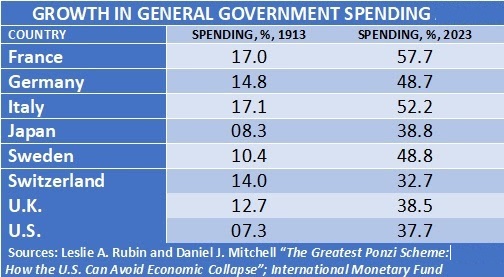
I suspect Keynesians would respond to these examples by asserting it’s okay – at least in theory – to restrain spending if the economy isn’t in recession.*

But then how do they respond to the experience of the Baltic nations? When the financial crisis hit a few years ago, those governments imposed genuine spending cuts and largely avoided the big tax hikes that have plagued other European nations.
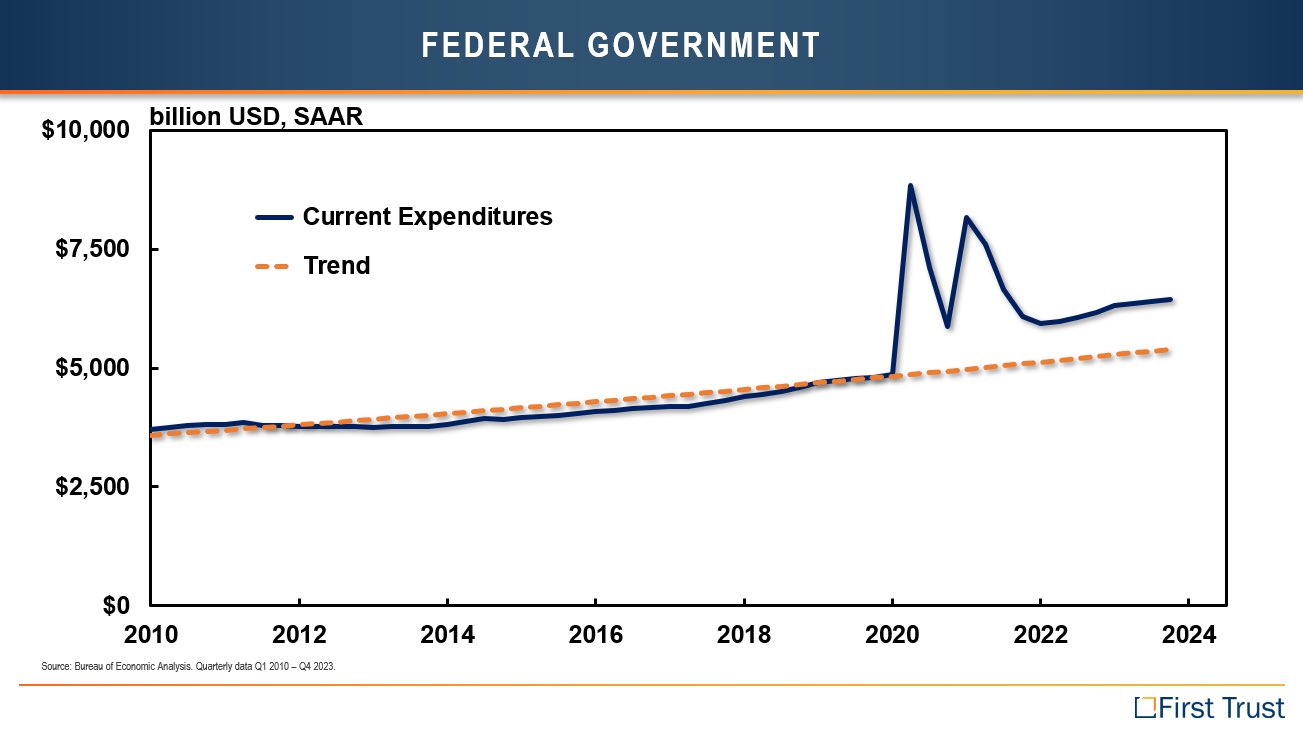
Now Estonia, Lithuania, and Latvia are enjoying impressive growth while the nations that raised taxes seem stuck in perpetual recession.**

So let’s recap. When nations try Keynesianism, they get bad result because more government spending isn’t conducive to growth.

When nations raise taxes, they get bad results because you don’t get more growth by penalizing work, saving, investment, and entrepreneurship.

But when nations reduce the burden of government spending and leave more resources in the productive sector, the economy recovers.

Seems like one side can declare victory and spike the football, but it’s not Paul Krugman and the Keynesians.

*I’m guessing one would be hard pressed to find any examples of modern-day Keynesians ever supporting fiscal restraint.

**Krugman tried to undermine the Baltic model of fiscal restraint by attacking Estonia, but wound up with egg on his face.

Read Full Post »

I’ve received several requests to comment on the controversy surrounding the famous Rogoff-Reinhart study on government debt and economic performance.

For those who haven’t followed this issue, Kenneth Rogoff and Carmen Reinhart wrote an influential paper in 2010 arguing that government debt above 90 percent of GDP was associated with weaker economic performance.

It turns out that the Rogoff and Reinhart made a mistake in their excel spreadsheet and this error was publicized in a recently unveiled article by three other economists.

This has led to a renewed debate about “austerity,” with R&R cast in the role of fiscal hawks and various critics saying that the mistake in their paper discredits that approach and that it’s time for Keynesian policies.

If you’re interested in the broader debate, here’s what Rogoff and Reinhart wrote in the New York Times to defend themselves, and here’s Paul Krugman’s criticism.

But if you want to know my opinion, I’m not a fan of either side. Unlike the Keynesians, I don’t think debt is good for growth. But I also think it doesn’t make sense to myopically focus on red ink.

Which explains why I’m very frustrated by the debate in Europe. On one side, you have the Keynesians advocating higher spending and on the other side you have “austerians” advocating higher taxes.*

No wonder I want both sides to lose!

As I’ve repeated over and over again, the real fiscal problem in most nations is the size of government. Excessive government spending is bad for prosperity, regardless of whether it is financed by taxes or borrowing.

To be sure, governments can accumulate so much debt that investors will get suspicious and demand very high interest rates before lending more money (sometimes referred to as an attack by “bond vigilantes”).

But it’s important to realize that debt is the symptom. The underlying disease is a bloated public sector. That’s true in Greece, Spain, Italy, and other nations that have had trouble borrowing money.

By the way, it’s also true in nations such as France and Belgium. Those countries also have governments that are far too big. They haven’t been hit (at least not yet) by the bond vigilantes, but they’re suffering from economic stagnation as well.

In other words, deficits are bad, but the real problem is spending. I elaborate in this Center for Freedom and Prosperity video.

The wise fiscal policy, needless to say, is to follow Mitchell’s Golden Rule. If the burden of government spending grows slower than the private economy, any nation can climb out of a fiscal ditch. Especially if they lower tax rates and avoid class-warfare tax policy.

*In theory, the “austerians” ” also advocate less spending, but you won’t be surprised to learn which option politicians select when given a choice between higher taxes and less spending.

P.S. You also won’t be surprised that Paul Krugman doesn’t do his homework when he writes about “austerity” in Estonia and the United Kingdom.

P.P.S. Please do not confuse “austerian” economics with “Austrian economics.” The former is a political rationale for tax hikes. The latter is a sensible school of economic thought.

Read Full Post »

Since I just left Monaco and am now in Geneva, this is an appropriate time to extol the virtues of so-called tax havens.

Monaco Casino

The name’s Bond….James Bond

But I don’t merely say nice things about low-tax jurisdictions when I’m in friendly environments.

I believe in swinging my sword in the belly of the beast.

That’s why I recently defended tax havens and tax competition for the fiscal heathens who read the New York Times.

In an even bigger display of futile optimism, I also just explained the benefits of tax competition, fiscal sovereignty, and financial privacy for the kleptocrats in Congress.

Here’s some of what I wrote for The Hill, starting with the obvious point that it is preposterous to blame tax havens for the financial crisis.

When the financial crisis hit, politicians from high-tax nations didn’t let the crisis go to waste. Acting through the G-20, they launched an attack on so-called tax havens, asserting that “hot money” from the offshore world somehow had caused the banking system to become unstable.  This campaign against low-tax jurisdictions made no sense. Nobody in the Cayman Islands or Monaco was responsible for the Federal Reserve’s easy money. Nobody in Panama or Singapore had anything to do with the corrupt system of Fannie Mae/Freddie Mac subsidies.

I then explained that tax havens once again are being attacked, though in this case multinational corporations are the main victims of a new scheme by the parasitical bureaucrats at the OECD.

So-called tax havens will suffer collateral damage, though, since big firms use them as very desirable platforms for a significant chunk of cross-border economic activity.

Tax havens are being attacked again… Funded with American tax dollars, the Organization for Economic Cooperation and Development (OECD) published a report on “Addressing Base Erosion and Profit Shifting,” (BEPS) and will follow up in a few months with specific recommendations.  This new OECD scheme is targeting multinational companies for a big tax hike, probably by requiring global tax returns, but that means tax havens are in the cross hairs because their pro-growth tax policies make them attractive locations for cross-border economic activity. Indeed, the OECD specifically has complained that “small jurisdictions act as conduits, receiving disproportionately large amounts of Foreign Direct Investment compared to large industrialised countries and investing disproportionately large amounts in major developed and emerging economies.” …its new campaign isn’t just targeting small tax havens, but will also undermine the relatively attractive fiscal systems in nations such as Ireland, Hong Kong, Switzerland, Slovakia, Singapore, Estonia, and the Netherlands. The burden of this will fall not on companies, but on workers, consumers, and shareholders.

I close with a warning that tax havens and tax competition are one of the few restraints on the greed of the political class. We need to preserve these liberalizing forces if we want to protect ourselves from even worse fiscal policy.

Tax Haven Article - The Hill…anti-tax haven demagoguery is perfectly acceptable in political circles since it is seen as expanding the power of government over taxpayers.  The real issue we should be addressing is whether we need some sort of external constraint to protect us from fiscal crises that are triggered by the overspending and overtaxing of the political class.  For a couple of decades following the Reagan and Thatcher tax cuts, governments around the world have been forced by tax competition to lower tax rates, reduce double taxation of saving and investment and reform their tax system.  Defenders of the welfare state and proponents of class-warfare tax policy have resented this liberalizing process and grab any opportunity to demonize tax havens, particularly since these jurisdictions have strong human rights laws that protect the financial privacy of investors.

For further information, I highly recommend the writings of Allister Heath and Pierre Bessard.

Read Full Post »

The fiscal policy debate often drives me crazy because far too many people focus on deficits.

The Keynesians argue that deficits are good for growth and this leads them to support more government spending.

The “austerity” crowd at places such as the International Monetary Fund, by contrast, argues that deficits are bad for growth and this leads them to support higher taxes.

Then you have institutions such as the Congressional Budget Office that want the worst of all worlds, supporting Keynesian spending in the short run while advocating higher taxes in the long run.

But since I don’t like higher spending or higher taxes, you can see why I want to pull my hair out.

With this in mind, I’m pleased that economists at the European Central Bank have released some new research on “Fiscal Composition and Long-Term Growth” which doesn’t reflexively assume that red ink is the key variable. Instead, they dispassionately look at how several fiscal policy variables impact economic performance.

Here is the general conclusion.

In this study we use a large panel of developed and developing countries for the period 1970-2008. …Specifically, we examine the following issues: the influence of which budgetary components have a stronger influence in affecting (positively or negatively) per capita GDP growth rates… Our evidence suggests that for the full sample…government expenditures appear with significant negative signs.

This makes sense. Whether financed by taxes or borrowing, excessive government expenditures hurt an economy by diverting resources from productive uses.

But not all government spending is created equal. Here are some of the specific findings.

In a nutshell, our results comprise notably: i) for the full sample revenues have no significant impact on growth whereas government expenditures have significant negative effects; ii) the same is true for the OECD sub-sample with the addition that total government revenues have a negative impact on growth; iii) taxes on income are less welcome for growth; iv) public wages, interest payments, subsidies and government consumption have a negative effect on output growth; v) expenditures on social security and welfare are less growth enhancing.

It’s noteworthy that government spending is negatively correlated with economic performance for both developing and advanced nations.

It’s also interesting that taxes on income are bad for growth everywhere, and overall revenue is bad for growth in advanced nations (both of these findings, incidentally, suggest that Obama’s class-warfare tax agenda is quite misguided).

The authors of the study also find that some forms of government spending are particularly harmful for growth. That also makes a lot of sense since I’ve explained in my video on the Rahn Curve that core public goods can be good for growth while other types of government spending undermine prosperity.

So what does all this mean? Simply stated, the fiscal problem in virtually all nations is not red ink. It’s big government. Large deficits aren’t desirable, to be sure, but they’re best understood as side effects of too much spending.

In other words, entitlements need to be reformed and discretionary spending needs to be reduced. Solve these underlying problems and you fix the symptoms of red ink and sluggish growth.

Read Full Post »

I’m not a very exciting guy. It’s Saturday afternoon and I’m perusing the Budget and Economic Outlook from the Congressional Budget Office.

But sometimes it pays to be a nerd because I just found an interesting tidbit of information. Here’s what CBO says about the anemic economic output we’re experiencing compared to the growth we should be enjoying.

…output is likely to remain below its potential (or maximum sustainable) level until 2017—almost a decade after the recession started in December 2007. CBO estimates that real GDP in the fourth quarter of 2012 was below its potential level by about 5½ percent; that gap is only modestly smaller than the gap (of about 7½ percent) that existed at the end of the recession in mid-2009 because growth in output since then has been only slightly faster, on average, than growth in potential output.

Let’s translate this bit of jargon into English.

What CBO actually is saying is that the economy hasn’t enjoyed the bounce of above-average growth that normally follows a recession (and we have more than 130 years of data showing this is the normal pattern). As a result, instead of recovering all the lost output associated with the downturn, we’re still suffering from sub-par levels of output.

CBO specifically says that we were “about 5½ percent” below potential at the end of last year. That’s about $880 billion of lost output. Not exactly a ringing endorsement of Obamanomics.

But that’s just part of the story. CBO also looks at the cumulative output gap.

With such a large gap between actual and potential output persisting for so long, the cumulative loss of output relative to the economy’s potential between 2007 and 2017 will be equivalent to nearly half of the output produced last year.

Since output last year was $16 trillion, the cumulative output gap is $8 trillion. That’s a ton of money, even by Washington standards.

Here’s a chart from CBO showing this output gap.

CBO Obama Growth Gap

By the way, I’m not sure I believe CBO’s estimate that we’ll get back to the trend line by 2017. Why expect good things when the economy is saddled by excessive taxation, wasteful spending, and burdensome regulation?

CBO Obama Growth Gap 2All that we know for sure is that the economy has been lagging, which is starkly evident if we simply look at actual data.

By the way, if you think I’m cherry picking numbers to make Obama look bad, my first reaction is to laugh since CBO leans way to the left and has zero reason to make Obama look bad. Remember, these are the clowns that tried to justify Obama’s Keynesian stimulus scheme.

But if you don’t want to believe the CBO data for inexplicable reasons, how about the Washington Post, which certainly is on the left side of the political spectrum? Surely they’re not part of the vast right-wing conspiracy, right?

Check out this chart they posted comparing the current recovery to a normal recovery, though you won’t be surprised to learn that they conveniently waited until after the election before sharing this vital bit of information.

Or what about the Minneapolis Federal Reserve, which has an interactive website enabling a reader to compare all the business cycles since the end of World War II.

These charts show both employment and output for every one of those business cycles. You can click to see larger versions, but all you need to know is that the current business cycle is the red line – and it happens to show that Obamanomics has generated the worst results whether we’re looking at jobs of GDP.

Minn Fed Data

None of this is to suggest, by the way, that Obama’s policies caused the recession. That happened on Bush’s watch.

But I am stating that Obama’s big-government policies have played a role in keeping the economy from enjoying a strong recovery. That’s been no post-recession bounce.

Ronald Reagan also inherited a dismal economy. He had to deal with high interest rates and inflation rather than a banking crisis, so I don’t know which President was dealt a worse hand of cards. But I know that Reagan’s policies of free markets and smaller government helped trigger an economic boom.

Obama, by contrast, basically has continued Bush’s policies of intervention and bigger government. No wonder we’re suffering a multi-trillion dollar output gap.

Read Full Post »

Art Laffer has a guaranteed spot in the liberty hall of fame because he popularized the common-sense notion that you can’t make any assumptions about tax rates and tax revenue without also figuring out what happens to taxable income.

Lot’s of people on the left try to denigrate the “Laffer Curve,” but it’s worth noting that even left-wing economists now admit that you don’t maximize revenue with a 100 percent tax rate.*

Indeed, I think the only people who now cling to that absurd view are the bureaucrats at the Joint Committee on Taxation.

But this post isn’t about the Laffer Curve. It’s about a disappointing column that Art Laffer wrote for today’s Wall Street Journal.

The issue is whether states should have the power to impose taxes on sales that take place outside their borders. Art starts the column with a very good point about the link between growth and living standards.

After enjoying an average growth rate above 3.5% per year between 1960 and 1999, Americans have had to make do with less than one-half that pace since 2000. The consequences are already dramatic and will become even more so over time. Overall we are 20% poorer today than we would be had the pre-2000 growth rate persisted.

That’s a great point. I’ve also tried to get people to focus on the importance of long-run growth.

Heck, just look at what’s happened in Hong Kong and Singapore and you’ll agree.

In his column, Art also correctly defines good tax policy.

The principle of levying the lowest possible tax rate on the broadest possible tax base is the way to improve the incentives to work, save and produce—which are necessary to reinvigorate the American economy and cope with the nation’s fiscal problems.

But he then asserts that an Internet sales tax cartel somehow will result in better policy.

…there are reforms that can alleviate the problems associated with declining sales-tax bases and, at the same time, allow the states to move closer to a pro-growth tax system. One such reform would be to have Internet sellers collect the sales taxes that are owed by in-state consumers when they purchase goods over the Web. So-called e-fairness legislation addresses the inequitable treatment of retailers based on whether they are located in-state (either a traditional brick-and-mortar store or an Internet retailer with a physical presence in the state) or out of state (again as a brick-and-mortar establishment or on the Internet). …The exemption of Internet and out-of-state retailers from collecting state sales taxes reduced state revenues by $23.3 billion in 2012 alone, according to an estimate by the National Conference of State Legislatures. The absence of these revenues has not served to put a lid on state-government spending. Instead, it has led to higher marginal rates in the 43 states that levy income taxes.

This is a very disappointing collection of sentences. Let’s review.

1. States have declining sales-tax bases because state lawmakers treat that levy the same way that politicians in Washington treat the income tax – they put in loopholes in exchange for campaign cash and political support. For them to complain about declining sales-tax bases is sort of like the old joke about the guy who murders  his parents and then asks the court for mercy because he’s an orphan.

2. Art offers zero evidence that state governments would use the additional revenue from a state sales tax cartel to reduce income tax rates. What’s next, a column saying we should have a value-added tax because the politicians may use the revenue to get rid of the income tax? Yeah, good luck with that approach.

3. Why is it “inequitable” for there to be different tax policies in different states? That’s another way of describing federalism, and it’s something we should be celebrating and promoting. Particularly since it promotes tax competition, which is one of the most effective ways of restraining the greed of the political class.

4. The Internet sales tax cartel being promoted by Art and various politicians requires that governments have the ability to tax sales that tax place outside their borders. That’s an assault of sovereignty, particularly since out-of-state merchants will be coerced into being tax collectors for a distant government. This is the same dangerous ideology that is used by high-tax governments to promote global anti-tax competition policies.

5. Art offers zero evidence that the absences of a state sales tax cartel has led to higher income tax rates. Yes, some states have raised tax rates in recent years, but others have lowered tax rates.

For more information on why a sales tax cartel among the states would be a bad idea, here’s my short speech to an audience on Capitol Hill.

*This should be an obvious point, but I can’t resist emphasizing that maximizing revenue should not be the goal of fiscal policy.

Read Full Post »

If America descends into Greek-style fiscal chaos, there’s no doubt that entitlement programs will be the main factor. Social Security, Medicare, Medicaid, and Disability are all fiscal train wrecks today, and the long-run outlook for these programs is frightful.

Just look at these numbers from the Bank for International Settlements and OECD to see how our fiscal future is bleaker than many of Europe’s welfare states.

If we don’t implement the right kind of entitlement reform, our children and grandchildren at some point will curse our memory.

But that doesn’t mean we shouldn’t worry about other parts of the budget, including the so-called discretionary programs that also have been getting bigger and bigger budgets over time.

That’s why I was a bit perturbed to read Veronique de Rugy’s piece in National Review Online, which implies that these programs are “shrinking” and being subject to a “Big Squeeze.”

…there is another number to look at in that budget. It’s the shrinking share of the budget consumed by discretionary spending (spending on things like defense and infrastructure) to make space for mandatory spending and interest. This is the Big Squeeze. …in FY 2014 mandatory spending plus interest will eat up 67 percent of the budget, leaving discretionary spending with 33 percent of the budget (down from 36 percent in FY 2012). Now by FY 2023, mandatory and interest spending will consume 77 percent of the total budget. Discretionary spending will be left with 23 percent of the budget.

But all that’s really happening here is that entitlement outlays are growing faster than discretionary spending.

Here’s some data from the Historical Tables of the Budget, showing what is happening to spending for both defense discretionary and domestic discretionary. And these are inflation-adjusted numbers, so the we’re looking at genuine increases in spending.

Discretionary Spending FY62-14

As you can see, defense outlays have climbed by about $100 billion over the past 50 years, while outlays for domestic discretionary programs have more than tripled.

If that’s a “Big Squeeze,” I’m hoping that my household budget experiences a similar degree of “shrinking”!

To be fair, Veronique obviously understands these numbers and is simply making the point that politicians presumably should have an incentive to restrain entitlement programs so they have more leeway to also buy votes with discretionary spending.

But I’d hate to think that an uninformed reader would jump to the wrong conclusion and decide we need more discretionary spending.

Particularly since the federal government shouldn’t be spending even one penny for many of the programs and department that are part of the domestic discretionary category. Should there be a federal Department of Transportation? A federal Department of Housing and Urban Development? A federal Department of Agriculture?

No, NO, and Hell NO. I could continue, but you get the idea.

The burden of federal government spending in the United States is far too high and it should be reduced. That includes discretionary spending and entitlement spending.

P.S. Since I don’t want to get on Veronique’s bad side, let me take this opportunity to call attention to her good work on properly defining austerity,. And if you watch her testimony to a congressional committee, it’s also quite obvious that she also understands that the real problem is bloated and wasteful government spending.

P.P.S. For those who don’t have the misfortune of following the federal budget, “entitlements” are programs that are “permanently appropriated,” which simply means that spending automatically changes in response to factors such as eligibility rules, demographic shifts, inflation, and program expansions. Sometimes these programs (such as Social Security, Medicare, Medicaid, etc) are referred to as “mandatory spending.”

The other big part of the budget is “discretionary spending” or “appropriations.” These are programs funded by annual spending bills from the Appropriations Committees, often divided into the two big categories of “defense discretionary” and “nondefense discretionary.”

Read Full Post »

Using data stolen from service providers in the Cook Islands and the British Virgin Islands, the Washington Post published a supposed exposé of Americans who do business in so-called tax havens.

Cayman April 2013

Another Research Trip to Cayman – One of the Sacrifices I Make in the Fight for Freedom

Since I’m the self-appointed defender of low-tax jurisdictions in Washington, this caught my attention. Thomas Jefferson wasn’t joking when he warned that “eternal vigilance is the price of liberty.” I’m constantly fighting against anti-tax haven schemes that would undermine tax competition, financial privacy, and fiscal sovereignty.

Even if it means a bunch of international bureaucrats threaten to toss me in a Mexican jail or a Treasury Department official says I’m being disloyal to America. Or, in this case, if it simply means I’m debunking demagoguery.

The supposedly earth-shattering highlight of the article is that some Americans linked to offshore companies and trusts have run afoul of the legal system.

Among the 4,000 U.S. individuals listed in the records, at least 30 are American citizens accused in lawsuits or criminal cases of fraud, money laundering or other serious financial misconduct.

But the real revelation is that people in the offshore world must be unusually honest. Fewer than 1 percent of them have been named in a lawsuit, much less been involved with a criminal case.

This is just a wild guess, but I’m quite confident that you would find far more evidence of misbehavior if you took a random sample of 4,000 Americans from just about any cross-section of the population.

We know we would find a greater propensity for bad behavior if we examined 4,000 politicians. And I assume that would be true for journalists as well. And folks on Wall Street. And realtors. And plumbers. Perhaps even think tank employees. Anyhow, you get the point.

Citing a couple of anecdotes, the reporter then tries to imply that low-tax jurisdictions somehow lend themselves to criminal activity.

 Fraud experts say offshore bank accounts and companies are vital to the operation of complex financial crimes. Allen Stanford, who ran a $7 billion Ponzi scheme, used a bank he controlled in Antigua. Bernard Madoff, who ran the largest Ponzi scheme in U.S. history, used a series of offshore “feeder funds” to fuel the growth of his multibillion-dollar house of cards.

The Allen Stanford case was a genuine black eye for the offshore world, but it’s absurd to link Madoff’s criminality to tax havens. The offshore funds that invested with Madoff were victimized in the same way that many onshore funds lost money.

Moreover, there’s no evidence in this article – or from any other source to my knowledge – suggesting that financial impropriety is more likely in low-tax jurisdictions.

We then get some “hard” numbers.

Today, there are between 50 and 60 offshore financial centers around the world holding untold billions of dollars at a time of historic U.S. deficits and forced budget cuts. Groups that monitor tax issues estimate that between $8 trillion and $32 trillion in private global wealth is parked offshore.

So we have offshore wealth of somewhere “between $8 trillion and $32 trillion”? With that level of precision, or lack thereof, perhaps you now understand why the make-believe numbers about alleged tax evasion are about as credible as a revenue estimate from the Joint Committee on Taxation.

Speaking of make-believe numbers, the article mentions one of Washington’s worst lawmakers, a Senator who pushed through a law that has united the world against the United States.

Sen. Carl M. Levin (D-Mich.) has been holding hearings and conducting investigations into the offshore world for nearly three decades. In 2010, Congress passed the Foreign Account Tax Compliance Act requiring that U.S. taxpayers report foreign assets to the government and foreign institutions alert the IRS when Americans open accounts.

He justifies bad policy by claiming that there’s a pot of gold at the end of the tax haven rainbow.

“We can’t afford to lose tens of billions of dollars a year to tax-avoidance schemes,” Levin said. “And many of these schemes involve the shift of U.S. corporate tax revenues earned here in the U.S. to offshore tax havens.”

But FATCA is predicted to collected less than $1 billion per year, and it probably will lose revenue once you include Laffer Curve effects such as lower investment in the American economy from overseas.

The most interesting part of the article, as least from a personal perspective, is that the Center for Freedom and Prosperity is listed as one of the “powerful lobbying interests” fighting to preserve tax competition.

The efforts by Levin and other lawmakers have been opposed by powerful lobbying interests, including the banking and accounting industries and a little-known nonprofit group called the Center for Freedom and Prosperity. CF&P was founded by Daniel J. Mitchell, a former Senate Finance Committee staffer who works as a tax expert for the Cato Institute, and Andrew Quinlan, who was a senior economic analyst for the Republican National Committee before helping start the center. …The center argues that unfettered access to offshore havens leads to lower taxes and more prosperity.

Having helped to start the organization, I wish CF&P was powerful. The Center has never had a budget of more than $250,000 per year, so it truly is a David vs. Goliath battle when we go up against bloated and over-funded bureaucracies such as the IRS and the Paris-based Organization for Economic Cooperation and Development.

The reporter somehow thinks it is big news that the Center has tried to raise money from the business community in low-tax jurisdictions.

According to records reviewed by The Post and ICIJ, the organization’s fundraising pleas have been circulated to offshore entities that make millions by providing anonymity for wealthy clients, many of them U.S. citizens.

Unfortunately, even though these offshore entities supposedly “make millions,” I’m embarrassed to say that CF&P has not been able to convince them that it makes sense to support an organization dedicated to protecting tax competition, financial privacy, and fiscal sovereignty.

But maybe that will change now that the OECD has launched a new attack on tax planning by multinational firms.

Let’s close by returning to the policy issue. The article quotes me defending the right of jurisdictions to determine their own fiscal affairs.

Mitchell, the co-founder of CF&P, added that nations shouldn’t be telling other countries how to conduct their affairs and noted that the United States is one of the worst offenders in the world when it comes to corporate secrecy.

My only gripe is that the reporter mischaracterizes my position. Yes, there are several states that are “tax havens” because of their efficient and confidential incorporation laws, but that means America is “one of the best providers,” not “one of the worst offenders.”

This is something to celebrate. I’m glad the United States is a safe haven for the oppressed people of the world. That’s great news for our economy. I just wish we also were a tax haven for American citizens.

“The United States is one of the biggest tax havens in the world,” Mitchell said. “In general, the United States is impervious to fishing expeditions here, and then the United States turns around and says, ‘Allow us to do fishing expeditions in your country.’”

But I’m not a hypocrite. Other nations should have the sovereign right to maintain pro-growth tax and privacy laws as well.

Other nations shouldn’t feel obliged to enforce bad American tax law, any more than we should feel obliged to enforce any of their bad laws.

P.S. You probably won’t be surprised to learn that “onshore” nations are much more susceptible to dirty money than “offshore” jurisdictions. Which is why you have a hard time finding any tax havens on this map showing the nations with the most money laundering.

P.P.S. On the topic of tax havens, you won’t be surprised to learn that Senator Levin is not the only dishonest demagogue in Washington. If you pay close attention around 1:25 and 2:25 of this video, you’ll see that the current resident of 1600 Pennsylvania Avenue also has an unfortunate tendency to play fast and loose with the truth.

Read Full Post »

Young people voted for Obama in overwhelming numbers, but the question is why?

As I explain in this interview for Blaze TV, they are being hurt by his policies.

It’s not just that youth unemployment is high. Obama’s policies also are hurting those who found jobs. Simply stated, these “lucky” folks are getting below-average pay.

The Stepford Students?

I specifically explain that academics have determined that those entering the labor market in a weak economy will suffer a long-run loss of income.

Some of you may think I’m clutching at straws because I don’t like Obama, but perhaps you’ll believe the man who formerly served as the Chairman of President Obama’s Council of Economic Advisers.

Here’s some of what Austin Goolsbee wrote several years ago for the New York Times.

…starting at the bottom is a recipe for being underpaid for a long time to come. Graduates’ first jobs have an inordinate impact on their career path and their “future income stream,” as economists refer to a person’s earnings over a lifetime. The importance of that first job for future success also means that graduates remain highly dependent on the random fluctuations of the economy, which can play a crucial role in the quality of jobs available when they get out of school.

Goolsbee cites some research based on the career paths of Stanford MBAs.

Consider the evidence uncovered by Paul Oyer, a Stanford Business School economist… He found that the performance of the stock market in the two years the students were in business school played a major role in whether they took an investment banking job upon graduating and, because such jobs pay extremely well, upon the average salary of the class. That is no surprise. The startling thing about the data was his finding that the relative income differences among classes remained, even as much as 20 years later.

He also reports on what other scholars found for regular college students.

Dr. Oyer’s findings hold for more than just high-end M.B.A. students on Wall Street. They are also true for college students. A recent study, by the economists Philip Oreopoulos, Till Von Wachter and Andrew Heisz…finds that the setback in earnings for college students who graduate in a recession stays with them for the next 10 years. These data confirm that people essentially cannot close the wage gap by working their way up the company hierarchy. While they may work their way up, the people who started above them do, too. They don’t catch up.

Now think about today’s young people. They’re buried in debt, thanks to government programs that have caused a third-party payer crisis. Yet they are having a hard time finding jobs because Obama’s policies are stunting the economy’s performance.

And even if they do find a job, the research suggests they will get paid less. Not just today, but for the foreseeable future.

Yet they gush over Obama. Go figure.

P.S. Goolsbee’s recent columns have been less impressive, perhaps because he feels the need to defend Obama.

P.P.S. I’m not suggesting that young people should have gushed over McCain or Romney. Just that they should view almost all politicians with disdain.

P.P.P.S. I also say in the interview that the government should get out of the housing business – both on the spending side of the budget and the revenue side of the budget. And it goes without saying that I also explain the need to reduce the burden of government spending.

Read Full Post »

Let’s take a moment and enjoy how Obama made himself a laughingstock because of his anti-sequester hysteria.

In spite of his hyperbolic rhetoric, nothing bad has happened. Schools are still open, planes are still flying, and supermarkets aren’t poisoning us with tainted food.

I’ve already shared some very funny cartoons on this topic, which can be viewed here, here, here, here, and here.

Lower down in this post, we have a couple of additional cartoons that deserve a few chuckles, but I also want to share this interview to help make an important policy point about the need to reduce the burden of government spending.

Actually, the sequester was a double victory. Not only did we trim the growth of spending, we also avoided the tax hike that Obama wanted as a replacement.

No wonder he’s so unhappy!

This first cartoon, from Chip Bok, captures his sullen mood.

Cartoon Sequester 1

The second cartoon, by Jerry Holbert, has the same these, showing that the American people have learned to ignore Obama’s demagoguery.

Cartoon Sequester 2

Now the question is what comes next?

I wrote yesterday that Obama is likely to offer a bait-and-switch budget designed to impose more taxes and more spending.

It’s possible, though, that it won’t be as far to the left as the budget approved by the Senate (as cartoonists have ably illustrated).

In any event, there is no possible compromise with the House-approved budget. Or, to be more specific, there’s no possible compromise that would be good for the nation, so we’re looking at stalemate for the near future.

But stalemate is a lot better than moving in the wrong direction.

Read Full Post »

Statists are in a tough position. For years, they’ve been saying the United States should be more like Europe.

And, as shown in these very funny cartoons by Michael Ramirez and Bob Gorrell, President Obama is a cheerleader for that effort.

But now Europe’s welfare states are collapsing, so the left is scrambling to come up with some way of rationalizing their support for ever-growing levels of taxation and spending

Paul Krugman’s been doing what he can to square this circle, complaining that Europe is in trouble because governments aren’t spending enough. Sounds preposterous, but at least he provides some comfort for the don’t-confuse-us-with-the-facts-we’re-Keynesians crowd.

But for those who prefer to look at real data, one of my Cato Institute colleagues has sorted through the numbers to see whether Krugman’s hypothesis has any validity. Here’s some of what Alan Reynolds wrote for Investor’s Business Daily, reprinted by Real Clear Politics, starting with a quick look at some nations that experienced growth during periods when the burden of government spending was falling.

In Iceland, which didn’t throw taxpayer money at the banks, government spending was slashed from 57.6% of GDP in 2008 to 46.5% in 2012. The deficit fell from 12.9% of GDP to 3.4%. The economy began to recover in 2011. Iceland’s economic boost from fiscal frugality was neither unorthodox nor unique. After all, the U.S. economy boomed in the late 1990s when federal spending was cut from 22.3% of GDP in 1991 to 18.2% in 2000. In Canada, total federal and provincial spending was deeply slashed from 53.2% of GDP in 1992 to 39.2% in 2007 with only salubrious effects.

But what about Krugman’s argument that spending cuts have hurt growth in nations such as Portugal, Ireland, Italy, Greece, Great Britain, and Spain?

Well, Alan points out that these nations haven’t reduced spending.

The PIIGGS imposed no austerity at all on the public sector in the past five years. Government spending on bailouts, subsidies, grants, salaries and entitlements commands a much larger share of these economies than it did just a few years ago.

If you break down the data on an annual basis, some of these nations have been forced by the financial crisis to finally reduce their budgets, but the cuts in the past year or two aren’t nearly enough to make up for the huge spending increases in earlier years.

But these governments have shown no reluctance to raises taxes. I’ve already discussed their unfortunate propensity to hike value-added tax rates. Alan explains that they’re doing the same thing for income tax rates.

European austerity has been focused on the private sector — namely, taxpayers with high incomes. That is the second thing the PIIGGS have in common. The highest income tax rate was recently increased in every one of the troubled PIIGGS except Italy (where it was already too high at 43%). The top tax rate was hiked from 40 to 46.5% in Portugal, from 41 to 48% in Ireland, from 40 to 45% in Greece, from 40 to 50% in Great Britain, and from 48 to 52% in Spain.

In other words, Veronique de Rugy is correct. The “austerity” in Europe generally has been in the form of higher taxes, squeezing the productive sector to prop up the public sector.

Though I would point out that there are a few bright spots. Switzerland has been doing quite well, thanks to a “debt brake” that limits how much the budget can grow each year.

And the Baltic nations deserve credit for imposing genuine budget cuts several years ago, a policy that has yielded big dividends since they’re now growing while most other European nations are mired in economic stagnation.

And they kept their flat tax systems, showing some appreciation for the common-sense insight that you don’t get more growth by punishing investors, entrepreneurs, and small business owners.

By the way, Alan’s column isn’t completely depressing. He writes that the burden of government spending is reasonable (at least compared to Europe’s bankrupt welfare states) in some of the major emerging economies.

And they’ve focused more on lowering tax rates rather than making them more punitive.

It is enlightening to compare the depressing performance of these tax-and-spend countries to the rapidly-expanding BRIC (Brazil, Russia, India and China) and MIST economies (Mexico, Indonesia, South Korea and Turkey). Government spending is frugal in these countries, averaging 32.1% of GDP in the BRICs and 27.4% for the MIST group. Rather than raising top tax rates, all but one of the BRIC and MIST countries slashed their highest individual income tax rates in half; sometimes lower. Brazil cut the top tax rate from 55 to 27.5%. Russia replaced income tax rates up to 60% with a 13% flat tax. India cut the top tax rate to 30% from 60%. Similarly, the top tax rate was cut from 55 to 30% in Mexico, from 50 to 30% in Indonesia, from 89 to 38% in South Korea, and from 75 to 35% in Turkey. In China, statutory income tax rates can still reach 45% on paper, but that is only for high salaries and is widely evaded. Investment income is subject to a flat tax of 20%, the corporate tax is 15-25%, and China’s extremely low payroll tax adds almost nothing to labor costs.

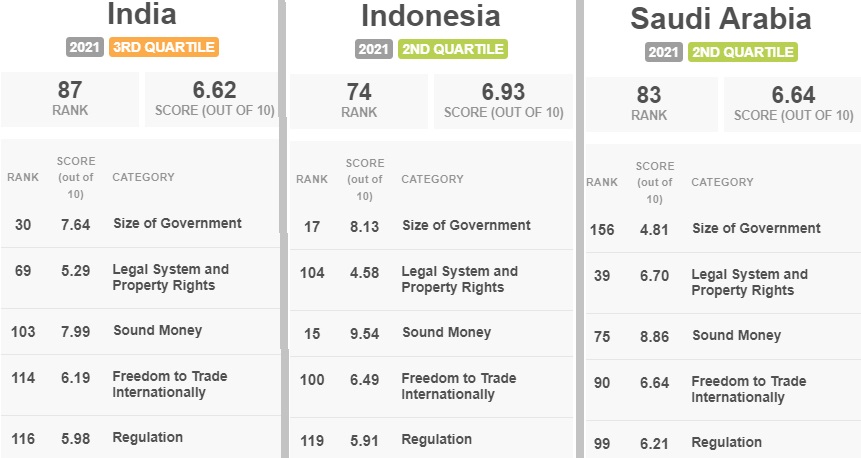
This doesn’t mean the BRIC and MIST nations deserve high praise. Many of them still get poor scores from Economic Freedom of the World, largely because the regulatory burden is excessive and also because more needs to be done to uphold the rule of law and protect property rights.

But at least most of them aren’t compounding those mistakes with Keynesian spending schemes and class-warfare tax policy.

For more information about nations that have benefited from spending restraint, here’s my video looking at Ireland in the 1980s, New Zealand and Canada in the 1990s, and Slovakia last decade.

The moral of the story, needless to say, is that good things happen when governments comply with Mitchell’s Golden Rule.

P.S. Paul Krugman received some much-deserved abuse when he made false attacks on Estonia’s admirable fiscal policy.

P.P.S. For some humor about the European fiscal mess, here are some laughable quotes from European leaders. This Robert Ariail cartoon also gets a laugh, as do these videos on a Greek view of Germans and a romantic conflict between Northern Europe and Southern Europe. My favorite, for what it’s worth, is this map showing how Greeks view the rest of Europe, with this Dave Barry column a close runner-up.

Read Full Post »

I’m normally reluctant to write about “depreciation” because I imagine eyes glazing around the world. After all, not many people care about the tax treatment of business investment expenses.

But I was surprised by the positive response I received after writing a post about Obama’s demagoguery against “tax loopholes” for corporate jets. So with considerable trepidation let’s take another look at the issue.

First, a bit of background. Every economic theory agrees that investment is a key for long-run growth and higher living standards. Even Marxist and socialist theory agrees with this insight (though they foolishly think government somehow is competent to be in charge of investments).

Let’s look at two remarkable charts, starting with one that shows the very powerful link between total investment and wages for workers.

As you can see (click the chart to see a larger version), if we want people to earn more money, it definitely helps for there to be more investment. More “capital” means that workers have higher productivity, and that’s the primary determinant of wages and salary.

Our second chart shows how the internal revenue code treats income that is consumed compared to how it penalizes income that is saved and invested. Simply stated, the current system is very biased against capital formation because of the combined impact of capital gains taxes, corporate income taxes, double taxes on dividends, and death taxes.

Indeed, one of the reasons why the right kind of tax reform will generate more prosperity is that double taxation of saving and investment is eliminated. With either a flat tax or national sales tax, economic activity is taxed only one time. No death tax, no capital gains tax, no double tax on dividends in either plan.

All of this background information helps underscore why it is especially foolish for the tax code to specifically penalize business investment. And this happens because companies have to “depreciate” rather than “expense” their investments.

Here’s how I described depreciation in my post on corporate jets.

If a company purchases a jet for $20 million, they should be able to deduct – or expense – that $20 million when calculating that year’s taxable income… A sensible tax system defines profit as total revenue minus total costs – including purchases of private jets. But today’s screwy tax code forces them to wait five years before fully deducting the cost of the jet (a process known as depreciation). Given that money today has more value than money in the future, this is a penalty that creates a tax bias against investment (the tax code also requires depreciation for purchases of machines, structures, and other forms of investment).

And I also addressed the issue when writing about the economic illiteracy in one of the Obama-Romney debates.

Now let’s see what some experts on the topic have to say.

Here’s some very sage analysis from Alan Viard of the American Enterprise Institute.

…a deal that cuts the corporate rate could end up doing more harm than good. The problem is that Congress and the Obama administration are thinking of pairing the rate cut with a slow-down of companies’ depreciation deductions. That’s a bad combination. A key goal of corporate tax reform should be to reduce the tax penalty on business investment. Investments in equipment, factories, and other forms of capital help power the long-run economic growth that boosts wages and living standards for American workers. …If depreciation is slowed down enough to offset the full revenue loss from the rate cut, then there’s no reduction in the investment penalty, on balance. The depreciation changes take back with the left hand everything that the rate cut gives with the right hand. …In fact, the policy makes the tax penalty on new investments bigger. …Why is this bad combination being considered? Maybe because the rate cut is easy to understand and the harm of slower depreciation is easy to overlook. …Yes, let’s cut the corporate tax rate. But, let’s not slow down depreciation to pay for it.

Amen. Proposals to lower America’s destructively high corporate tax rate are needed, but I don’t want politicians “paying for” the change with other policies that are similarly harmful to growth and competitiveness.

Margo Thorning of the American Council for Capital Formation adds some wisdom with her column in today’s Wall Street Journal.

…proposals that would increase the tax burden on capital-intensive industries—which are contributing to U.S. economic growth and employment—should be viewed with caution. …stretching out depreciation allowances reduces a company’s annual cash flow and raises the “hurdle rate” that new investments would have to meet before they are approved. For capital-intensive firms in sectors such as energy, manufacturing, utilities and transportation, the trade-off between delayed cash flow and lower corporate income-tax rates may result in cutbacks in capital spending. …Each additional $1 billion in investment is associated with 23,000 new jobs, according to data from the Department of Commerce and the Bureau of Labor Statistics. …Rather than drawing out depreciation schedules, a better, pro-growth approach to corporate tax reform would be to allow all investment to be expensed—in other words, deducted from income in the first year.

I share Margo’s concerns, which is why I’m very suspicious when the President says he wants to lower the corporate tax rate and “reform” the system.

Last but not least, Matt Mitchell (no relation) of the Mercatus Center recently added his two cents to the discussion.

The idea that “accelerated” depreciation is a loophole can be traced back to Stanley Surrey, the Harvard law professor whose work in the 1950s, 60s, and 70s influenced many…, including Senator Bill Bradley. …immediate expensing would mean abandoning “the attempt to tax business income.” That’s because it would essentially turn the corporate income tax into a corporate consumption tax. And that may be a good thing. Capital taxation is notoriously inefficient. This is one reason why Robert Hall and Alvin Rabushka permitted immediate 100 percent expensing in their famous flat consumption tax.

You should realize, by the way, that the distorted view of what’s a loophole doesn’t just apply to depreciation. The Joint Committee on Taxation (the same folks who basically assume that the revenue-maximizing tax rate is 100 percent) also tells lawmakers that it’s a loophole if you don’t double-tax capital gains, or if you allow people to avoid double taxation by utilizing IRAs.

With advice like that, no wonder the tax code is a mess.

Anyhow, congratulations are in order. If you’ve made it this far, you almost surely know more about depreciation than every single politician in Washington. Though, to be sure, that’s not exactly a big achievement.

Read Full Post »

Back in 2010, I wrote a post entitled “What’s the Ideal Point on the Laffer Curve?

Laffer CurveExcept I didn’t answer my own question. I simply pointed out that revenue maximization was not the ideal outcome.

I explained that policy makers instead should seek to maximize prosperity, and that this implied a much lower tax rate.

But what is that tax rate, several people have inquired?

The simple answer is that the tax rate should be set to finance the legitimate functions of government.

But that leads to an obvious follow-up question. What are those legitimate functions?

According to my anarcho-capitalist friends, there’s no need for any public sector. Even national defense and courts can be shifted to the private sector.

In that case, the “right” tax rate obviously is zero.

But what if you’re a squishy, middle-of-the-road moderate like me, and you’re willing to go along with the limited central government envisioned by America’s Founding Fathers?

That system operated very well for about 150 years and the federal government consumed, on average, only about 3 percent of economic output. Historical Burden of Federal SpendingAnd even if you include state and local governments, overall government spending was still less than 10 percent of GDP.

Moreover, for much of that time, America prospered with no income tax.

But this doesn’t mean there was no tax burden. There were excise taxes and import taxes, so if the horizontal axis of the Laffer Curve measured “Taxes as a Share of GDP,” then you would be above zero.

Or you could envision a world where those taxes were eliminated and replaced by a flat tax or national sales tax with a very low rate. Perhaps about 5 percent.

So I’m going to pick that number as my answer, even though I know that 5 percent is nothing more than a gut instinct.

For more information about the growth-maximizing size of government, watch this video on the Rahn Curve.

There are two key things to understand about my discussion of the Rahn Curve.

First, I assume in the video that the private sector can’t provide core public goods, so the discussion beginning about 0:33 will irk the anarcho-capitalists. I realize I’m making a blunt assumption, but I try to keep my videos from getting too long and I didn’t want to distract people by getting into issues such as whether things like national defense can be privatized.

Second, you’ll notice around 3:20 of the video that I explain why I think the academic research overstates the growth-maximizing size of government. Practically speaking, this seems irrelevant since the burden of government spending in almost all nations is well above 20 percent-25 percent of GDP.

But I hold out hope that we’ll be able to reform entitlements and take other steps to reduce the size and scope of government. And if that means total government spending drops to 20 percent-25 percent of GDP, I don’t want that to be the stopping point.

At the very least, we should shrink the size of the state back to 10 percent of economic output.

And if we ever get that low, then we can have a fun discussion with the anarcho-capitalists on what else we can privatize.

P.S. If a nation obeys Mitchell’s Golden Rule for a long enough period of time, government spending as a share of GDP asymptotically will approach zero. So perhaps there comes a time where my rule can be relaxed and replaced with something akin to the Swiss debt brake, which allows for the possibility of government growing at the same rate as GDP.

Read Full Post »

Folks, the pendulum is swinging in the right direction.

PendulumIn recent weeks, I’ve shared a bunch of examples to support my hypothesis that libertarians, small-government conservatives, and classical liberals are finally making some progress.

This trend actually started with the fiscal cliff, though that was simply a smaller-than-expected defeat.

Since then, we’ve enjoyed victories on the sequester, the IMF, and dynamic scoring. I’ve also posted some evidence showing that the Tea Party has made a positive difference and specifically shared data showing that the burden of government fiscal policy has been reduced since the 2010 elections.

Well, here’s another feel-good story. A powerful Committee Chairman in the House of Representatives realizes that being pro-market is not the same as being pro-business. Hallelujah!

The Wall Street Journal reports:

During Jeb Hensarling’s first congressional bid, a man at a campaign stop in Athens, Texas, asked the Republican if he was “pro-business.” “No,” the candidate replied, drawing curious stares from local business leaders who had gathered to hear him speak, a former Hensarling aide recalled. “I’m not pro-business. I’m pro-free enterprise.” Now, more than a decade later, that distinction has Wall Street on edge. The new chairman of the House financial services committee wants to limit taxpayers’ exposure to banking, insurance and mortgage lending by unwinding government control of institutions and programs the private sector depends on, from mortgage giants Fannie Mae and Freddie Mac to flood insurance. Banks and other large financial institutions are particularly concerned because Mr. Hensarling plans to push legislation that could require them to hold significantly more capital and establish new barriers between their federally insured deposits and other activities, including trading and investment banking. …In interviews, a half-dozen industry representatives expressed some level of anxiety about Mr. Hensarling’s legislative agenda.

So, the cronyists are “on edge” and feeling “anxiety.” Gee, just breaks my heart.

And it’s not just Rep. Hensarling that is singing from the right song sheet.

Earlier this month, all 45 Senate Republicans voted for a symbolic measure aimed at banks with more than $500 billion in assets. The amendment, offered by Sens. David Vitter (R., La.) and Sherrod Brown (D., Ohio), sought to eliminate any subsidies or other advantages enjoyed by the biggest financial institutions because investors expect the government to prevent them from collapsing. …Most congressional Republicans believe the changes enacted in the wake of the 2008 financial crisis—principally in the Dodd-Frank financial reform bill—enshrined the notion that the biggest institutions are “too big to fail” because they guaranteed the government would step in to prevent the most sprawling firms from going under.

To be sure, many of these same politicians voted for TARP, so I’m not under any illusions that they’ve become committed supporters of genuine capitalism.

Putting taxpayers before Wall Street

Though Hensarling did vote the right way, so I’m confident that he understands that insolvent banks should be liquidated rather than bailed out.

Too bad folks in the Bush Administration didn’t understand this simple principle of free markets.

Here are some more details from the article about Hensarling’s commitment to economic liberty.

Mr. Hensarling has been a vocal critic of taxpayer backstops for the private sector. He voted against the Wall Street rescue package in the fall of 2008 and supported measures to ease the importation of prescription drugs. He even picked a fight with one of the largest employers in his backyard—American Airlines—by supporting initiatives to allow more long-distance flights out of Dallas’s Love Field, the home base for rival Southwest Airlines. Now, his other potential targets include: the Export-Import Bank of the U.S., which makes loans to American companies that do business overseas, and the Terrorism Risk Insurance Act, a temporary backstop created in the aftermath of 9/11 to insure construction projects. The latter measure expires at the end of 2014, unless Mr. Hensarling’s committee acts to extend it. “In every jurisdictional area that I can get my fingers on, I want to move us away from the Washington insider economy,” he said. Mr. Hensarling sharpened his free-market views when he studied economics under former Sen. Phil Gramm at Texas A&M University.

I’m especially happy to see that he wants to end the corrupt system of subsidies from the Export-Import Bank, which is a typical example of big businesses being anti-free market.

So what does all this mean? Perhaps not much in the short run, particularly with Obama in the White House and Tim Johnson of South Dakota chairing the Senate Banking Committee.

In the long run, though, this is a positive sign. Our prosperity and liberty depend on small government and free markets, so we need at least a few lawmakers who understand that there shouldn’t be any special favors for big interest groups.

Read Full Post »

If I live to be 100 years old, I suspect I’ll still be futilely trying to educate politicians that there’s not a simplistic linear relationship between tax rates and tax revenue.

You can’t double tax rates, for instance, and expect to double tax revenue. Simply stated, there’s another variable – called taxable income – that needs to be added to the equation. This simple insight is what gives us the Laffer Curve.

This is common sense in the business community. No restaurant owner would ever be foolish enough to think that revenues will double if all prices increase by 100 percent. People in the real world know that this would mean lower sales.

At best, revenues will rise by much less than 100 percent in that scenario. And if sales drop by enough, revenues may actually fall.

Perhaps because so few of them have business experience, it seems that politicians have a hard time grasping this simple concept.

The latest examples come from Europe, where the never-ending greed for more revenue has resulted in the imposition of financial transaction taxes.

So how’s that working out? Are politicians collecting the revenue they expected?

Hardly. Here are some of the details from a City A.M. column.

…taxes on financial transactions across Europe have devastated market activity and failed to raise as much as politicians hoped, according to new figures out yesterday.

The article cites three powerful examples, starting with Hungary.

Hungary implemented a 0.1 per cent tax at the start of the year. But it raised less than half the revenue the state had hoped for, bringing in 13bn Hungarian Forints (£36m) in January.

Wow, less than 50 percent of the revenue that politicians were expecting. But the politicians probably don’t care about the collateral damage they’re imposing on the economy because they’ll get to buy votes with another 13 billion Forints (about $55 million).

Popeye Laffer CurveNow let’s see how the French are doing.

France forged ahead on its own, introducing a 0.2 per cent tax on sales of shares of major firms. But that only raised €200m (£169.4m) from August to November, well below to €530m expected.

Gee, what a shame, the politicians in Paris are only getting about one-third as much money as they were expecting. That’s even worse than Hungary.

But they’ll surely squander that bit of cash as fast as possible.

Our last example comes from Italy. There are no revenue numbers yet, but the decline in financial activity suggests this tax also will be a flop.

And Italy launched its FTT this month. Figures from TMF Group suggest it has cut trading volumes by 38 per cent already

Though politicians may decide it’s a success since they may get more than 50 percent of what they were originally estimating.

That kind of forecasting error would get somebody fired at any private business, but being a politician means never having to say you’re sorry.

And it certainly never means learning from mistakes. The evidence on the Laffer Curve is ubiquitous, with powerful examples in Ireland, the United Kingdom, Italy, France, Spain, as well as Bulgaria and Romania. Or states such as IllinoisOregonFlorida, Maryland, Washington, DC, and New York.

P.S. Even President Obama has sort of acknowledged the supply-side principles that are the basis of the Laffer Curve.

P.P.S. Remember that the goal of good tax policy is NOT to maximize revenue.

P.P.P.S. I warned the European Union’s Taxation Commissioner about the dangers of a tax on financial transactions last year. Needless to say, my sage counsel appears to have been ignored.

Read Full Post »

I’m not a fan of the International Monetary Fund. It galls me that a bunch of bureaucrats enjoy opulent lifestyles at our expense, and don’t even have to pay on their lavish incomes.

But I might be willing to overlook all that if it wasn’t for the fact that IMF routinely and reflexively pushes for bad policy.

And the icing on the cake is that the IMF was created for the purpose of helping the manage the system of fixed exchange rates that was imposed after World War II. That system no longer exists, yet the IMF is still plaguing us.

I’ll be happy if they simply take their hands out of my pockets

I remember reading someplace that cockroaches were the only animals that would survive a nuclear war. I have no idea if that’s true, but it appears that international bureaucracies have similar survival skills.

But I’m digressing. Notwithstanding all the bad news listed above, we’re celebrating some good news today.

Here’s the situation. The IMF has been so busy subsidizing bad policy around the world with lots of bailouts that the gold-plated bureaucracy wants American approval to permanently misallocate more of the world’s capital.

I’ve explained over and over again why it’s not a good idea to give more matches to a pyromaniac. But I never expected that lawmakers would do the right thing.

Yet they have, so let’s enjoy this fleeting experience. Here are some excerpts from a Reuters report.

…lawmakers…rebuffed a request by the Obama administration to approve a permanent increase in U.S. funding to the International Monetary Fund in a setback for IMF reforms to boost the voting power of emerging economies. The reforms need congressional approval because they involve shifting and making permanent a $65 billion U.S. contribution to an IMF crisis fund. …the U.S. Treasury sought to tuck the provision into pending legislation in Congress that aims to avoid a U.S. government shutdown at the end of March. The Republican-controlled House of Representatives rejected the IMF funding request last week, but the administration hoped the Democratic-led Senate would include it in its version of the funding bill. After days of negotiations, authors of the bill in the Senate Appropriations Committee rejected the request as too politically sensitive in the tense budget environment in Washington, where the sweeping government spending cuts triggered on March 1 are starting to be felt.

Wow. I wrote previously that rejecting additional IMF handouts was a minimum test of GOP seriousness in the battle against statism.

And they actually cleared that hurdle. Miracles do happen!

But there’s no such thing as a permanent victory in the battle against statism.

The Obama administration will have another shot at winning approval for increased IMF voting power when Congress starts work on a new set of spending bills later this spring for the 2014 fiscal year, which starts on October 1. But failure by President Barack Obama to reach a deal with Republicans to shrink the U.S. budget deficit could complicate any new requests for IMF funding, aides cautioned.

Not only is there no such thing as a permanent victory, even this bit of short-run success probably doesn’t mean much. If I understand correctly, the IMF already received the authority to squander the additional $65 billion. All that’s really happening now is a fight over whether to grant the bureaucrats permanent approval to misuse the funds.

But I’ll take any victory. Fighting for freedom in Washington is a rather grim task. Yet in the past month, we got the sequester and now we’ve stiff-armed the IMF.

I’m almost delirious with joy.

P.S. While the IMF almost always pushes bad policy, there are occasional glimmers of sanity from the economists on staff who write reports. Researchers at the international bureaucracy, for instance, have acknowledged the Laffer Curve and warned that it makes no sense to push taxes too high. And some of the bureaucrats have even admitted that it sometimes make sense to reduce the burden of government spending.

And even though it wasn’t their intention, IMF bureaucrats even provided very strong evidence showing why the value-added tax is a destructive money machine for big government.

Read Full Post »

I’ve been very critical of the Organization for Economic Cooperation and Development. Most recently, I criticized the Paris-based bureaucracy for making the rather remarkable assertion that a value-added tax would boost growth and employment.

But that’s just the tip of the iceberg.

Now the bureaucrats have concocted another scheme to increase the size and scape of government. The OECD just published a study on “Addressing Base Erosion and Profit Shifting” that seemingly is designed to lay the groundwork for a radical rewrite of business taxation.

In a new Tax & Budget Bulletin for Cato, I outline some of my concerns with this new “BEPS” initiative.

…the BEPS report…calls for dramatic changes in corporate tax policy based on the presumption that governments are not seizing enough revenue from multinational companies. The OECD essentially argues that it is illegitimate for businesses to shift economic activity to jurisdictions that have more favorable tax laws. …The core accusation in the OECD report is that firms systematically—but legally—reduce their tax burdens by taking advantage of differences in national tax policies.

Ironically, the OECD admits in the report that revenues have been trending upwards.

…the report acknowledges that “… revenues from corporate income taxes as a share of gross domestic product have increased over time. …Other than offering anecdotes, the OECD provides no evidence that a revenue problem exists. In this sense, the BEPS report is very similar to the OECD’s 1998 “Harmful Tax Competition” report, which asserted that so-called tax havens were causing damage but did not offer any hard evidence of any actual damage.

To elaborate, the BEPS scheme should be considered Part II of the OECD’s anti-tax competition project. Part I was the attack on so-called tax havens, which began back in the mid- to late-1990s.

The OECD justified that campaign by asserting there was a need to fight illegal tax evasion (conveniently overlooking, of course, the fact that nations should not have the right to impose their laws on what happens in other countries).

The BEPS initiative is remarkable because it is going after legal tax avoidance. Even though governments already have carte blanche to change business tax policy.

…governments already have immense powers to restrict corporate tax planning through “transfer pricing” rules and other regulations. Moreover, there is barely any mention of the huge number of tax treaties between nations that further regulate multinational taxation.

So what does the OECD want?

…the OECD hints at its intended outcome when it says that the effort “will require some ‘out of the box’ thinking” and that business activity could be “identified through elements such as sales, workforce, payroll, and fixed assets.” That language suggests that the OECD intends to push global formula apportionment, which means that governments would have the power to reallocate corporate income regardless of where it is actually earned.

And what does this mean? Nothing good, unless you think governments should have more money and investment should be further penalized.

Formula apportionment is attractive to governments that have punitive tax regimes, and it would be a blow to nations with more sensible low-tax systems. …business income currently earned in tax-friendly countries, such as Ireland and the Netherlands, would be reclassified as French-source income or German-source income based on arbitrary calculations of company sales and other factors. …nations with high tax rates would likely gain revenue, while jurisdictions with pro-growth systems would be losers, including Ireland, Hong Kong, Switzerland, Estonia, Luxembourg, Singapore, and the Netherlands.

Since the United States is a high-tax nation for corporations, why should Americans care?

For several reasons, including the fact that it wouldn’t be a good idea to give politicians more revenue that will be used to increase the burden of government spending.

But most important, tax policy will get worse everywhere if tax competition is undermined.

…formula apportionment would be worse than a zero-sum game because it would create a web of regulations that would undermine tax competition and become increasingly onerous over time. Consider that tax competition has spurred OECD governments to cut their corporate tax rates from an average of 48 percent in the early 1980s to 24 percent today. If a formula apportionment system had been in place, the world would have been left with much higher tax rates, and thus less investment and economic growth. …If governments gain the power to define global taxable income, they will have incentives to rig the rules to unfairly gain more revenue. For example, governments could move toward less favorable, anti-investment depreciation schedules, which would harm global growth.

You don’t have to believe me that the BEPS project is designed to further increase the tax burden. The OECD admits that higher taxes are the intended outcome.

The OECD complains that “… governments are often under pressure to offer a competitive tax environment,” and that “failure to collaborate … could be damaging in terms of … a race to the bottom with respect to corporate income taxes.” In other words, the OECD is admitting that the BEPS project seeks higher tax burdens and the curtailment of tax competition.

Writing for Forbes, Andy Quinlan of the Center for Freedom and Prosperity highlights how the BEPS scheme will undermine tax competition and enable higher taxes.

…the OECD wants to undo taxpayer gains made in recent decades thanks to tax competition. Since the 1980′s, average global income taxes on both individuals and corporations have dropped significantly, improving incentives in the productive sector of the economy to generate economic growth. These pro-growth reforms are the result of tax competition, or the pressure to adopt competitive economic policies that is put on governments by an increasingly globalized society where both labor and capital are mobile. Tax competition is the only force working on the side of taxpayers, which explains the organized campaign by global elite to defeat it. …If taxpayers want to preserve gains made thanks to tax competition, they must be weary of the threat posed by global tax cartels though organizations such as the OECD.

Speaking of the OECD, this video tells you everything you need to know.

The final kicker is that the bureaucrats at the OECD get tax-free salaries, so they’re insulated from the negative impact of the bad policies they want to impose on everyone else.

That’s even more outrageous than the fact that the OECD tried to have me thrown in a Mexican jail for the supposed crime of standing in the public lobby of a public hotel.

Anguilla 2013P.S. I just gave a speech to the Anguilla branch of the Society for Trust and Estate Professionals, and much of my remarks focused on the dangers of the BEPS scheme.

I took this picture from my balcony. As you can see, there are some fringe benefits to being a policy wonk.

And I travel to Nevis on Sunday to give another speech.

Tough work, but somebody has to do it. Needless to say, withe possibility of late-season snow forecast for Monday in the DC area, I’m utterly bereft I won’t be there to enjoy the experience.

Read Full Post »

I’m a sucker for a good flowchart because they either can help to simplify analysis or they can show how something is very complex.

Some of my favorites include:

I’d like to see a good fiscal policy flowchart, one that captures all the options for policymakers.

I created a matrix early last year to illustrate some of the goals and tradeoffs, but it wasn’t comprehensive.

Well, the folks at the UK-based Social Market Foundation have stepped into the breach and put together a flowchart that seems to cover every option.

They call it “The Gordian Knot of Growth.” It’s designed for the UK Chancellor of the Exchequer (akin to our Treasury Secretary and Office of Management and Budget Director), but I think the various boxes also capture almost all of the various policy prescriptions in the US.

Fiscal Flow Chart

But notice that I said this flowchart presents “almost all” of the options. You’ll notice that there’s no box for “tax increases” or “higher marginal tax rates.” That will give you an idea of how Obama’s class-warfare tax policy is way out of the mainstream.

For what it’s worth, I belong in more than one category. I’m an “Expansionary fiscal contractionist,” as well as a “Deregulator” and (under the TINA options) a supporter of “Long term measures.”

In other words, the burden of government spending should be reduced and we should allow markets to allocate resources.

Read Full Post »

Regular readers know that I’m a big advocate of the Laffer Curve, which is the common-sense notion that higher tax rates will cause people to change their behavior in ways that reduce taxable income.

Laffer CurveBut that doesn’t mean “all tax cuts pay for themselves.” Yes, that happened when Reagan lowered tax rates on the “rich” in the 1980s, but there are also tax cuts that generate little or no revenue feedback.

The key thing to understand is that revenue feedback is driven by the degree to which a tax cut leads to more taxable income. And you tend to get bigger changes in taxable income when you lower rates on taxpayers who have considerable control over the timing, level, and composition of their income.

Who are those taxpayers?

Most of us don’t fall in that category. Cutting my tax rate, for instance, probably won’t have much impact on taxable income. My salary from Cato is already established, so there’s not much opportunity for a “supply-side” effect. Every so often I can earn some extra money by writing an article or giving a speech, but (unfortunately!) not enough for it to make a difference even if my incentives are altered.

But investors, entrepreneurs, corporate managers, and small business owners are among those who do have considerable flexibility to respond when incentives change.

Consider this new research from the Tax Foundation, which finds big “supply-side” responses from a lower corporate tax rate. Let’s start with their description of the problem.

The United States currently imposes the highest statutory corporate tax rate in the developed world. …the steep rate discourages U.S. companies from investing as much as they would otherwise and reduces their competitiveness in international markets. …A major barrier to cutting the U.S. corporate tax rate, however, is the reported revenue cost. According to conventional revenue analyses, such as those performed by Congress’s Joint Committee on Taxation (JCT), a lower corporate tax rate would be an expensive revenue loser.

The Tax Foundation then explains why the current revenue-estimating system is misguided.

In reality, the trade-off posited by conventional revenue estimates is misleading. The estimates overstate the revenue cost of cutting the corporate rate and overstate the potential revenue gains from increasing it, because they ignore tax-induced growth effects. Most notably, Congress’s JCT has adopted the static assumption that tax changes have absolutely no impact, for good or ill, on total production, employment, investment, consumption, and other macroeconomic aggregates. …The static assumption has the advantage of simplicity, and it is not too far from the truth for tax changes that either have little impact on incentives at the margin or affect parameters that do not respond much to incentives. This is an extremely unrealistic assumption, however, in the case of the corporate income tax rate.

Bingo. You can click here for more information on why the Joint Committee on Taxation is wrong, and you may be interested to know that fewer than 15 percent of CPAs agree with the JCT’s assumptions.

Using more realistic assumptions, the Tax Foundation calculates the real-world impact of a lower corporate tax rate.

The Tax Foundation’s dynamic simulation model provides quantitative estimates of the growth and revenue effects. The model estimates, for example, that cutting the federal corporate tax rate from 35 percent to 25 percent would raise GDP by 2.2 percent, increase the private-business capital stock by 6.2 percent, boost wages and hours of work by 1.9 percent and 0.3 percent, respectively, and increase total federal revenues by 0.8 percent.

Indeed, they look at a wide range of options and show us “static” estimates based on JCT-type methodology and “dynamic” estimates based on a model that includes changes in taxable income.

Tax Foundation Corporate Tax Revenue-Maximizing Rate

One very important point is that the Tax Foundation looks at the impact of a lower corporate tax rate on all forms of tax revenue.

Federal receipts include many taxes, fees, and payments other than the corporate income tax, such as the personal income tax, payroll taxes, and excises. The size of the economy strongly influences the amounts these taxes, fees, and other payments collect. This is relevant because of the corporate income tax’s big GDP effects. A wide range of federal receipts will expand when a lower corporate income tax rate grows the economy but shrink when a higher corporate income tax downsizes the economic pie.

The study then mentions that the revenue-maximizing corporate tax rate is 14 percent, but warns that this doesn’t mean policy makers should make that their goal.

Although a corporate rate of 14 percent would maximize federal receipts, counting all types of federal revenue, it would not be the optimal rate for the economy unless very little value is placed on people’s incomes and the quantities of goods and services they can consume or invest. The model estimates that while cutting the corporate rate from the revenue-maximizing rate of 14 percent to zero would cost $9 billion of federal revenue, GDP would rise by roughly $300 billion, a payoff of about 33 to 1.

Amen to that point. Our goal isn’t to maximize revenue for the clowns in Washington. The ideal point on the Laffer Curve is where you maximize growth.

If you want my two cents on the topic, you maximize growth when you raise the revenue needed to finance the legitimate functions of government – and that requires a lots less revenue than we’re collecting now according to scholarly evidence on the “Rahn Curve.”

Finally, the Tax Foundation research points out that there’s a difference between the short-run revenue-maximizing rate and the long-run revenue-maximizing rate.

The federal corporate income tax is unusual because the feedbacks there are so strong that cutting the tax’s rate would, over a broad range, more than pay for itself in terms of federal revenues, with the bonus of lifting the incomes and productivity of people throughout the economy. Nevertheless, a corporate rate cut would reduce federal revenues during a transition period, because the rate cut would begin immediately, while it would take several years for the capital stock to expand sufficiently in response to the new incentives to generate the growth needed to return revenues to their prior level.

This chart illustrates this point, using the example of a 25 percent rate.

Tax Foundation Corporate Tax Long-Run Revenue Impact

In other words, the goal of good policy should be to improve the economy’s long-run performance. Over time, that results in more taxable income – a point that even the Congressional Budget Office acknowledges.

The one partial exception to this relationship between good tax policy and long-run tax revenue is the capital gains tax. Lowering that levy can cause big changes to short-run revenue because investors have complete control over when to sell assets. But the reason to lower – or ideally eliminate – that tax is to boost long-run prosperity.

So why aren’t policy makers embracing a lower corporate tax rate? On the right, there should be lots of support because of hostility to high tax rates. And on the left, there should be lots of support because of a desire for more tax revenue. Seems like a match made in Heaven.

But that assumes that folks on the left are motivated by a desire to maximize tax revenue. If you want to know the biggest obstacle to sensible tax policy, pay close attention beginning at the 4:34 mark of this video.

Read Full Post »

Two months ago exactly, I appeared on TV to talk about the concept of eliminating the personal and corporate income tax in Louisiana.

Now Governor Jindal has unveiled a specific proposal.

The plan will eliminate two major tax types: personal income tax and corporate income and franchise tax. Eliminating income taxes in a revenue-neutral manner and improving sales tax administration will dramatically simplify Louisiana’s tax system and reduce administrative problems for families and small businesses. The effective start date of the program is January 1, 2014. …The plan will ensure revenue neutrality by…[b]roadening the state sales tax base and raising the state rate to 5.88%.

This is a superb plan.

Of all the possible ways for a state to generate revenue, the income tax is the most destructive.

My new man crush

That’s why researchers consistently have found that states without this punitive levy grow faster and create more jobs.

It’s also worth noting that jurisdictions such as Monaco, Bermuda, and the Cayman Islands manage to be very prosperous in the absence of an income tax, though the incredible wealth of these places is partly a function of bad policy elsewhere, so the comparison isn’t perfect.

Anyhow, Gov. Jindal expands on this research with some very powerful data.

Over the last ten years, more than 60 percent of the three million new jobs in American were created by the nine states without an income tax. Every year for the past 40 years, states without an income tax had faster growth than states with the highest income taxes.  Economic growth in the nine states without income taxes was 50 percent faster than in the nine states with the highest top income tax rates.  Over the past decade, states without income taxes have seen nearly 60 percent higher population growth than the national average. …While we have reversed the more than two-decade problem of out-migration, we can do more to keep people here. Here are a couple of staggering statistics. Between 1995 and 2010, according to IRS data, Louisiana lost $3 billion in adjusted gross income to Texas.

Amen.

I particularly like that he recognizes the power of tax competition as an argument for better tax policy. Taxpayers win when Texas and Louisiana compete to have less oppressive tax systems.

Indeed, this should help explain why I am so fixated on the importance of making governments compete with each other. Simply stated, governments are very prone to over-tax and over-spend if they think taxpayers have no escape options.

So let’s keep our fingers crossed that Gov. Jindal’s proposal gets a friendly reception from the state legislature.

If he succeeds, I imagine he will vault himself to the top tier of Republicans looking to replace Obama.

And, who knows, maybe he can reinvigorate the argument that we can replace the corrupt internal revenue code with a national sales tax?

P.S. Jindal is good on more than just tax policy. He’s already implemented some good school choice reform, notwithstanding wretched and predictable opposition from the state’s teachers’ union.

Read Full Post »

I wrote about the Ryan budget two days ago, praising it for complying with Mitchell’s Golden Rule and reforming Medicare and Medicaid.

But I believe in being honest and nonpartisan, so I also groused that it wasn’t as good as the 2011 and 2012 versions.

Now it’s time to give the same neutral and dispassionate treatment to the budget proposed by Patty Murray, the Washington Democrat who chairs the Senate Budget Committee.

But I’m going to focus on a theme rather than numbers.

One part of her budget got me particularly excited. Her Committee’s “Foundation for Growth” blueprint makes a very strong assertion about the fiscal and economic history of the Clinton years.

The work done in the 1990s helped grow the economy, create jobs, balance the budget, and put our government on track to eliminate the national debt.

As elaborated in this passage, the 42nd President delivered very good results.

President Bill Clinton entered office in 1993 at a time when the country was facing serious deficit and debt problems. The year before, the federal government was taking in revenue equal 17.5 percent of GDP, but spending was 22.1 percent of the economy—a deficit of 4.7 percent. …The unemployment rate went from 7 percent at the beginning of 1993 to 3.9 percent at the end of 2000. Between 1993 and 2001, our economy gained more than 22 million jobs and experienced the longest economic expansion in our history.

And the Senate Democrats even identified one of the key reasons why economic and fiscal policy was so successful during the 1990s.

…federal spending dropped from 22.1 percent of GDP to 18.2 percent of GDP.

I fully agree with every word reprinted above. That’s the good news.

So what, then, is the bad news?

Well, Senator Murray may have reached the right conclusion, but she was wildly wrong in her analysis. For all intents and purposes, she claims that the 1993 tax hike produced most of the good results.

President Clinton’s 1993 tax deal…brought in new revenue from the wealthiest Americans and…our country created 22 million new jobs and achieved a balanced budget. President Clinton’s tax policies were not the only driver of economic growth, but our leaders’ ability to agree on a fiscally sustainable and economically sound path provided valuable certainty for American families and businesses.

First, let’s dispense with the myth that the 1993 tax hike balanced the budget. I obtained the fiscal forecasts that were produced by both the Congressional Budget Office and the Office of Management and Budget in early 1995 because I wanted to see whether a balanced budget was predicted.

As you can see in the chart, both of those forecasts showed perpetual deficits of about $200 billion. And these forecasts were made nearly 18 months after the Clinton tax hike was implemented.

So if even the White House’s own forecast from OMB didn’t foresee a balanced budget, what caused the actual fiscal situation to be much better than the estimates?

The simple answer is that spending was restrained. You can give credit to Bill Clinton. You can give credit to the GOP Congress that took power in early 1995. You can give the credit to both.

But regardless of who gets the credit, the period of spending restraint that began at that time was the change that produced a budget surplus, not the tax hike that was imposed 18 months earlier and which was associated with perpetual red ink.

But spending restraint tells only part of the story. With the exception of the 1993 tax hike, the Clinton years were a period of shrinking government and free market reform.

Clinton RecordTake a look at my homemade bar chart to compare the good policies of the 1990s with the bad policies. It’s not even close.

You may be thinking that my comparison is completely unscientific, and you’re right. I probably overlooked some good policies and some bad policies.

And my assumptions about weighting are very simplistic. Everything is equally important, with a big exception in that I made the government spending variable three times as important as everything else.

Why? Well, I think reducing the burden of government spending during the Clinton years was a major achievement.

But maybe we shouldn’t rely on my gut instincts. So let’s set aside my created-at-the-spur-of-the-moment bar chart and look at something that is scientific.

This chart is taken directly from Economic Freedom of the World, which uses dozens of variables to measure the overall burden of government.

As you can see, the United States score improved significantly during the Clinton years, showing that economic freedom was expanding and the size and scope of government was shrinking.

In other words, Patty Murray is correct. She is absolutely right to claim that Bill Clinton’s policies “helped grow the economy, create jobs, balance the budget.”

Now she needs to realize that those policies were small government and free markets.

Read Full Post »

Sigh. Even when they’re sort of doing the right thing, Republicans are incapable of using the right argument.

Paul Ryan, Chairman of the House Budget Committee, has unveiled his proposed budget and he and other Republicans are bragging that the plan will balance the budget in 10 years.

That’s all fine and well, but good fiscal policy is achieved by reducing the burden of government spending, and that means that restraining the budget so that federal outlays grow slower than the private sector.

It’s good to balance the budget, of course, but that should be a secondary goal.

Now for the good news. The Ryan Budget does satisfy the Golden Rule of fiscal policy. As you can see in the chart, federal spending grows by an average of 3.4 percent annual, and that modest bit of fiscal discipline is enough to reduce the burden of government spending to 19.1 percent of economic output by 2023.

Ryan FY2014 Budget

It’s also good news that the Ryan Budget calls for structural reform of entitlement programs, including Medicaid block grants and Medicare premium support. The budget also assumes the repeal of the costly Obamacare program.

And there’s also some good tax policy. Not bold tax reform like a flat tax, but top tax rates would be reduced to 25 percent and many forms of double taxation like the death tax and capital gains tax presumably would be reduced or eliminated.

Let’s be clear, though, that this is not a libertarian budget. Federal spending will still be far too high. Indeed, the budget will consume a larger share of the economy than it did when Bill Clinton left office.

And while Republicans do a good job of restraining spending in the first couple of years of the new Ryan Budget, outlays rise far too rapidly beginning around 2016.

Moreover, there’s no Social Security reform.

Equally worrisome, the budget assumes that the federal tax burden should remain about 19 percent of GDP, higher than the long-run average of 18 percent of GDP and – for all intents and purposes – permanently enshrining Obama’s fiscal cliff victory.

And it’s depressing to see that the Ryan budget has gotten weaker each year.

At this rate, it won’t be that long before the GOP budget and Obama budget converge.

Okay, that’s an exaggeration. But the moral of the story is that the Ryan Budget is a step in the right direction, but much more will be needed to restore limited, constitutional government.

Read Full Post »

I’m a proponent of a pro-growth and non-corrupt tax code.

I mostly write and talk about the flat tax, though I’d be happy to instead accept a national sales tax if we could somehow get rid of the 16th Amendment and replace it with something so ironclad that even Justices such as John Roberts and Ruth Bader Ginsburg couldn’t rationalize that the income tax was constitutional.

But since there’s no chance of any good tax reform with Obama in the White House, there’s no need to squabble over the best plan. Instead, our short-term goal should be to educate voters so that we create a more favorable intellectual climate for genuine reform in 2017 and beyond.

That’s why I’ve argued in favor of lower tax rates and shared the latest academic research showing that tax policy has a significant impact on economic performance.

But tax reform also means getting rid of the rat’s nest of deductions, credits, exemptions, preferences, exclusions, shelters, loopholes, and other distortions in the tax code.

Why? Because people should make decisions on how to earn income and how to spend income on the basis of what makes economic sense, not because they’re being bribed or penalized by the tax code. That’s just central planning through the back door.

And if you don’t think this is a problem, I invite you to peruse three startling images, each of which measures rising complexity over time.

  1. The number of pages in the tax code.
  2. The number of special tax breaks.
  3. The number of pages in the 1040 instruction booklet.

Today’s Byzantine system is good for tax lawyers, accountants, and bureaucrats, but it’s bad news for America. We need to wipe the slate clean and get rid of this corrupt mess.

But as I explain in this appearance on Fox Business News, we won’t make progress until we control the burden of government spending and unless we make sure that deductions are eliminated only if we use every penny of revenue to lower tax rates.

I’ve previously explained why it’s okay to get rid of itemized deductions for mortgage interest, charitable contributions, and state and local tax payments.

Let’s now take a moment to explain why the internal revenue code shouldn’t be artificially steering capital toward state and local governments at the expense of private investment.

Under current law, there’s no federal income tax imposed on interest from municipal bonds. No matter how rich you are, Uncle Sam doesn’t tax a penny of the interest you receive if you use your wealth to lend money to state and local governments.

Should the tax code steer money to Detroit politicians?

This “muni-bond exemption” has two unfortunate effects.

  • It makes it easier and cheaper for state and local governments to incur debt, thus encouraging more wasteful spending by cities such as Detroit and states such as California.
  • By making the debt of state and local governments more attractive than private business investment, the loophole undermines long-term growth by diverting capital to unproductive uses.

The politicians at the state and local level certainly understand what’s at stake. They’re lobbying to preserve this destructive tax break. Here are some excerpts from a story in the New York Times.

Mr. Firestine [of Montgomery County, MD] is on the front lines of a lobbying campaign by local and state governments, bond dealers, insurers and underwriters that is trying to pre-empt any attempt to limit or even kill the tax exemption. …At present, the federal government forgoes about $32 billion a year in taxes by exempting the interest that investors earn from municipal bonds. …The National Commission on Fiscal Responsibility and Reform, known as the Simpson-Bowles commission, has suggested taxing all municipal bond interest, not just the interest paid to people in the top bracket. …Officials of some other government groups, like the New York City Housing Development Corporation, have formed a coalition with Wall Street groups like the Bond Dealers of America to lobby on the issue. But there is the sense of an uphill battle. …Capping the tax exemption would cause high-bracket taxpayers to look for higher-yielding investments, he said, and the county would have to offer more interest to lure them back.

Based on the last sentence in the excerpt, I gather we’re supposed to think it would be bad news if we got rid of this tax preference and taxpayers shifted more of their money to private-sector investments.

Needless to say, that’s misguided. Only in the upside-down world of Washington do people think it is smart to create tax preferences that lead to more wasteful spending by state and local governments, while simultaneously imposing punitive forms of double taxation on saving and investment in the private sector.

By the way, this shouldn’t be an ideological issue. If this amazing chart is any indication, leftists who want workers to enjoy more income should be clamoring the loudest for a tax system that doesn’t tilt the playing field against capital formation.

P.S. While simplicity is a good goal for tax policy, you will understand why it shouldn’t be the only goal if you check out this potential Barack Obama tax reform plan.

Read Full Post »

As you can see here and here, I’m a huge fan of Ronald Reagan.

But it’s not just that the Gipper had good rhetoric. He also did a decent job of restraining spending and he significantly lowered marginal tax rates.

Combined with other pro-market reforms and his stalwart willingness to rein in inflation, as well as the fact that his policies led to the collapse of the evil Soviet Empire, I don’t think it’s an exaggeration that Reagan saved America.

That being said, he may not be the greatest president of the 20th century.

I’ve already shared a famous Calvin Coolidge video to show he said the right things. But, even more important, he did the right things.

Here’s some of what Amity Shlaes wrote about Coolidge for today’s Wall Street Journal.

…while Reagan inspired and cut taxes, he did not reduce the deficit. He did not even cut the budget. But if you look back, past Dwight Eisenhower and around the curve of history, you can find a Republican who did all those things: Calvin Coolidge. …The 30th president cut the top income-tax rate to 25% (lower than the 28% of the historic Reagan cut of 1986). Coolidge reduced the national debt and balanced the budget. When he departed the White House for his home in Northampton, Mass., he left a federal budget smaller than the one he found. …”I am for economy, and after that I am for more economy,” Coolidge told voters… The jovial Harding had vetoed only six bills. Coolidge vetoed 50. “It is much more important to kill bad bills than to pass good ones,” Coolidge once advised his father.

That last sentence should be repeated as often as possible. Indeed, it’s the reason why I mocked USA Today for calling Congress unproductive.

Since I’m guessing more than 90 percent of legislation undermines our liberty, we’re far better off when lawmakers do nothing.

Anyhow, you won’t be surprised to learn that the Gipper appreciated Coolidge.

President Reagan recognized Coolidge’s achievement, and upon taking office in 1981 he had a neglected Coolidge picture restored to a place of honor near Lincoln and Jefferson in the Cabinet Room.

And if you want to see some evidence of Coolidge’s superb economic stewardship, here’s a look at what happened with both economic output and the burden of government spending.

Coolidge Record

One final point. Just like Reagan was far from perfect, the same is true of Coolidge. I’ve never studied the economics of the 1920s, but it seems likely that some of the policies of that decade (perhaps excess credit expansion by the Federal Reserve?) helped set the stage for an economic downturn.

Though it’s also clear that the statist policies of Hoover and Roosevelt turned the downturn into a Great Depression.

Bush and Obama are sort of the modern version of Hoover and Roosevelt, though fortunately not nearly as bad.

Obama, for instance, raised the top tax rate from 35 percent to 39.6 percent as part of his class-warfare agenda. Hoover, by contrast, boosted the top rate from 25 percent to 63 percent and FDR then pushed it to 77 percent.

P.S. I already gave Amity’s new book on Coolidge a plug as part of my post about the flat tax-sales tax debate at Hillsdale. But in case you didn’t get the hint, here’s where you can order it.

Read Full Post »

What’s the revenue-maximizing tax rate?

Since I’m interested in the growth-maximizing tax rate instead, I don’t think that’s even a legitimate question.

That being said, it seems like everyone – both on the left and on the right – should agree that it makes no sense to set tax rates so high that the government loses revenue.

That implies, after all, that the tax system is so punitive that the revenue-raising impact of the higher tax rate is more than offset by the revenue-losing impact of lower taxable income.

But if you ask five economists to identify the revenue-maximizing point, you’ll probably get nine answers.

But one thing we can say for sure is that the revenue-maximizing tax rate on Manny Pacquiao is less than 39.6 percent.

Here are some details from Yahoo Sports.

Manny Pacquiao’s chief adviser insisted Monday that the Filipino superstar’s preference is for his next bout – a fifth fight against Juan Manuel Marquez – to take place away from Las Vegas, with the off-shore Chinese gambling resort of Macau emerging as the “favorite.” The Dec. 8 fight between Manny Pacquiao and Juan Manuel Marquez was held at the MGM Grand in Las Vegas. (AP)Michael Koncz told Yahoo! Sports that the 39.6 percent tax rate Pacquiao would face if he were to fight again in the U.S. makes a fall bout in Las Vegas “a no go.” Promoter Bob Arum…said Pacquiao would not have to pay taxes if the fight takes place in casinos in either Singapore or Macau. “Manny can go back to Las Vegas and make $25 million, but how much of it will he end up with – $15 million?” Arum said. “If he goes to Macau, perhaps his purse will only be $20 million, but he will get to keep it all, so he will be better off.”

This is just an isolated example, to be sure, but I’ve already shared IRS data confirming that the rich have tremendous control over the timing, level, and composition of their income.

And just as is the case with athletes like Pacquiao (and soccer players), wealthy investors and entrepreneurs also have the ability to take advantage of tax competition by shifting economic activity to jurisdictions with better tax policy.

Indeed, these are some of the reasons why upper-income taxpayers wound up paying more money to the IRS after Reagan cut the top tax rate from 70 percent to 28 percent.

Sadly, Barack Obama seems to have a hard time grasping the relationship between tax rates, taxable income, and tax revenue – even though I prepared a simple lesson to help him understand the that there’s not a simplistic linear relationship.

So maybe this short video will help him understand the basic concept of the Laffer Curve.

Then again, maybe the President understands, but just doesn’t care. He’s already stated, after all, that he favors more punitive tax policies even if the government doesn’t collect any extra revenue.

P.S. Just in case you’re not convinced by some IRS data and the experiences of a boxer, there is lots of empirical evidence for the Laffer Curve.

Read Full Post »

Older Posts »

Follow

Get every new post delivered to your Inbox.

Join 1,726 other followers

%d bloggers like this: