Feeds:
Posts
Comments

Archive for the ‘Laffer Curve’ Category

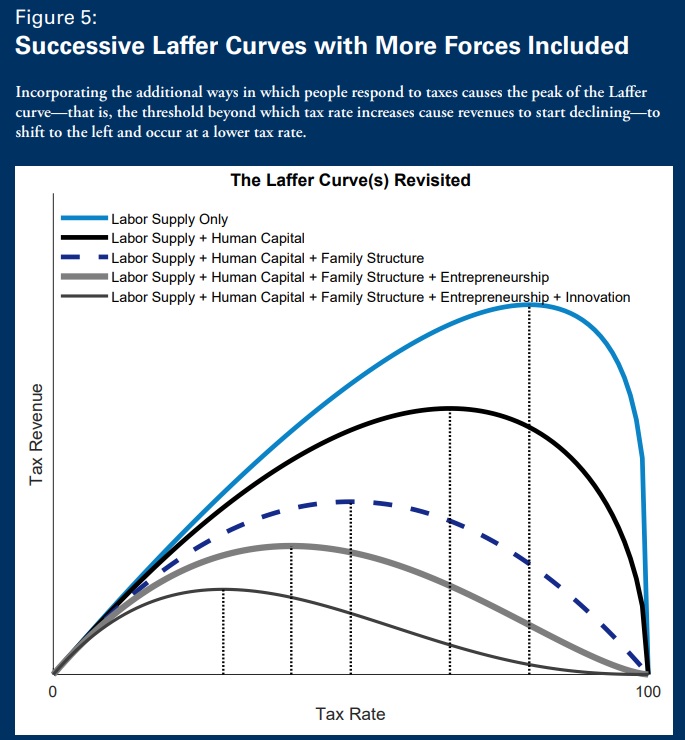
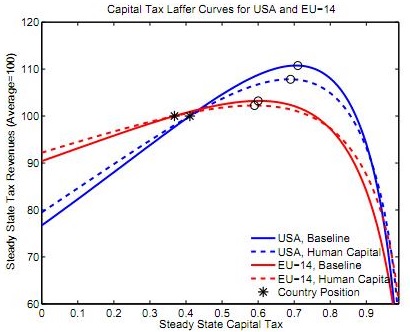
I feel like I’m on the witness stand and I’m being badgered by a hostile lawyers. Readers keep asking me to identify the revenue-maximizing point on the Laffer Curve.

But I don’t like that question. In the past, I’ve explained that the growth-maximizing point on the Laffer Curve is where enough revenue is raised to finance the legitimate – and limited – functions of government.

And one of the earliest posts on this blog explained that we don’t want to maximize tax revenue.

But I still get versions of this question, including a few that accuse me of dodging the issue.

So what the heck, I may as well give an answer to the question. But I won’t give my answer. Instead, I’ll provide the analysis of a Nobel Prize winner.

James Mirrlees won the Nobel Prize in Economics in 1996 and he’s researched this issue, starting with a left-of-center perspective.

Many economists, including Mirrlees, want to use the tax system to achieve a higher degree of equality than would otherwise obtain. This means taking a substantial amount of the additional income of high-income people, which would imply high marginal tax rates on them. But when the government imposes such high marginal tax rates on the highest-income people, it reduces the incentive of the most productive people to be productive. …Economists have long wanted to figure out the optimum, but until Mirrlees’s work no one had been able to solve it.

And what did Mirrlees find? Well, notwithstanding his own preferences, he calculated that the tax rate should be no higher than 20 percent.

Mirrlees started with no presumption against high marginal tax rates. Indeed, he has been an adviser to Britain’s Labour Party, which for decades imposed marginal tax rates in excess of 80 percent. But Mirrlees found that the top marginal tax rate should be only about 20 percent; and moreover, it should be about the same 20 percent for everyone. In short, Mirrlees’s work justified what is now known as a “flat tax,” more appropriately called a “flat tax rate.” Mirrlees wrote, “I must confess that I had expected the rigourous analysis of income taxation in the utilitarian manner to provide arguments for high tax rates. It has not done so.”

Not only a rate of 20 percent, but a flat tax!

Too bad the Labour Party politicians don’t listen to his advice. Heck, the Conservative Party politicians don’t follow his advice either.

But at least we have a rigorous estimate of the revenue-maximizing point on the Laffer Curve.

Though I hasten to add that it’s not the ideal tax rate. As the risk of being repetitive, the tax system should only fund the legitimate functions of government. For much of our history, the government only consumed about 10 percent of economic output and we didn’t need any broad-based tax. So you know where I stand.

That being said, it’s clearly destructive to have tax rates that are above both the growth-maximizing level and the revenue-maximizing level. And that’s where we stand now.

For more information, here’s my video on the Laffer Curve.

And if you want to learn specifically why Obama’s class-warfare agenda is misguided, here’s my Laffer-Curve-lesson-for-Obama post.

P.S. The Tax Foundation has estimated that the revenue-maximizing corporate tax rate is 14 percent.

Read Full Post »

Art Laffer has a guaranteed spot in the liberty hall of fame because he popularized the common-sense notion that you can’t make any assumptions about tax rates and tax revenue without also figuring out what happens to taxable income.

Lot’s of people on the left try to denigrate the “Laffer Curve,” but it’s worth noting that even left-wing economists now admit that you don’t maximize revenue with a 100 percent tax rate.*

Indeed, I think the only people who now cling to that absurd view are the bureaucrats at the Joint Committee on Taxation.

But this post isn’t about the Laffer Curve. It’s about a disappointing column that Art Laffer wrote for today’s Wall Street Journal.

The issue is whether states should have the power to impose taxes on sales that take place outside their borders. Art starts the column with a very good point about the link between growth and living standards.

After enjoying an average growth rate above 3.5% per year between 1960 and 1999, Americans have had to make do with less than one-half that pace since 2000. The consequences are already dramatic and will become even more so over time. Overall we are 20% poorer today than we would be had the pre-2000 growth rate persisted.

That’s a great point. I’ve also tried to get people to focus on the importance of long-run growth.

Heck, just look at what’s happened in Hong Kong and Singapore and you’ll agree.

In his column, Art also correctly defines good tax policy.

The principle of levying the lowest possible tax rate on the broadest possible tax base is the way to improve the incentives to work, save and produce—which are necessary to reinvigorate the American economy and cope with the nation’s fiscal problems.

But he then asserts that an Internet sales tax cartel somehow will result in better policy.

…there are reforms that can alleviate the problems associated with declining sales-tax bases and, at the same time, allow the states to move closer to a pro-growth tax system. One such reform would be to have Internet sellers collect the sales taxes that are owed by in-state consumers when they purchase goods over the Web. So-called e-fairness legislation addresses the inequitable treatment of retailers based on whether they are located in-state (either a traditional brick-and-mortar store or an Internet retailer with a physical presence in the state) or out of state (again as a brick-and-mortar establishment or on the Internet). …The exemption of Internet and out-of-state retailers from collecting state sales taxes reduced state revenues by $23.3 billion in 2012 alone, according to an estimate by the National Conference of State Legislatures. The absence of these revenues has not served to put a lid on state-government spending. Instead, it has led to higher marginal rates in the 43 states that levy income taxes.
This is a very disappointing collection of sentences. Let’s review.

1. States have declining sales-tax bases because state lawmakers treat that levy the same way that politicians in Washington treat the income tax – they put in loopholes in exchange for campaign cash and political support. For them to complain about declining sales-tax bases is sort of like the old joke about the guy who murders  his parents and then asks the court for mercy because he’s an orphan.

2. Art offers zero evidence that state governments would use the additional revenue from a state sales tax cartel to reduce income tax rates. What’s next, a column saying we should have a value-added tax because the politicians may use the revenue to get rid of the income tax? Yeah, good luck with that approach.

3. Why is it “inequitable” for there to be different tax policies in different states? That’s another way of describing federalism, and it’s something we should be celebrating and promoting. Particularly since it promotes tax competition, which is one of the most effective ways of restraining the greed of the political class.

4. The Internet sales tax cartel being promoted by Art and various politicians requires that governments have the ability to tax sales that tax place outside their borders. That’s an assault of sovereignty, particularly since out-of-state merchants will be coerced into being tax collectors for a distant government. This is the same dangerous ideology that is used by high-tax governments to promote global anti-tax competition policies.

5. Art offers zero evidence that the absences of a state sales tax cartel has led to higher income tax rates. Yes, some states have raised tax rates in recent years, but others have lowered tax rates.

For more information on why a sales tax cartel among the states would be a bad idea, here’s my short speech to an audience on Capitol Hill.

*This should be an obvious point, but I can’t resist emphasizing that maximizing revenue should not be the goal of fiscal policy.

Read Full Post »

Back in 2010, I wrote a post entitled “What’s the Ideal Point on the Laffer Curve?

Laffer CurveExcept I didn’t answer my own question. I simply pointed out that revenue maximization was not the ideal outcome.

I explained that policy makers instead should seek to maximize prosperity, and that this implied a much lower tax rate.

But what is that tax rate, several people have inquired?

The simple answer is that the tax rate should be set to finance the legitimate functions of government.

But that leads to an obvious follow-up question. What are those legitimate functions?

According to my anarcho-capitalist friends, there’s no need for any public sector. Even national defense and courts can be shifted to the private sector.

In that case, the “right” tax rate obviously is zero.

But what if you’re a squishy, middle-of-the-road moderate like me, and you’re willing to go along with the limited central government envisioned by America’s Founding Fathers?

That system operated very well for about 150 years and the federal government consumed, on average, only about 3 percent of economic output. Historical Burden of Federal SpendingAnd even if you include state and local governments, overall government spending was still less than 10 percent of GDP.

Moreover, for much of that time, America prospered with no income tax.

But this doesn’t mean there was no tax burden. There were excise taxes and import taxes, so if the horizontal axis of the Laffer Curve measured “Taxes as a Share of GDP,” then you would be above zero.

Or you could envision a world where those taxes were eliminated and replaced by a flat tax or national sales tax with a very low rate. Perhaps about 5 percent.

So I’m going to pick that number as my answer, even though I know that 5 percent is nothing more than a gut instinct.

For more information about the growth-maximizing size of government, watch this video on the Rahn Curve.

There are two key things to understand about my discussion of the Rahn Curve.

First, I assume in the video that the private sector can’t provide core public goods, so the discussion beginning about 0:33 will irk the anarcho-capitalists. I realize I’m making a blunt assumption, but I try to keep my videos from getting too long and I didn’t want to distract people by getting into issues such as whether things like national defense can be privatized.

Second, you’ll notice around 3:20 of the video that I explain why I think the academic research overstates the growth-maximizing size of government. Practically speaking, this seems irrelevant since the burden of government spending in almost all nations is well above 20 percent-25 percent of GDP.

But I hold out hope that we’ll be able to reform entitlements and take other steps to reduce the size and scope of government. And if that means total government spending drops to 20 percent-25 percent of GDP, I don’t want that to be the stopping point.

At the very least, we should shrink the size of the state back to 10 percent of economic output.

And if we ever get that low, then we can have a fun discussion with the anarcho-capitalists on what else we can privatize.

P.S. If a nation obeys Mitchell’s Golden Rule for a long enough period of time, government spending as a share of GDP asymptotically will approach zero. So perhaps there comes a time where my rule can be relaxed and replaced with something akin to the Swiss debt brake, which allows for the possibility of government growing at the same rate as GDP.

Read Full Post »

Because I’ve been sharing good news recently – which definitely is not my normal style, I joked the other day I must be on coke, in love, or rolling in money. For example:

Well, the drugs, love, and money must still be in my system because I’m going to share some more good news. Our lords and masters in Washington have taken a small step in the direction of recognizing the Laffer Curve.

Here are some details from a Politico report.

Here’s one Republican victory that went virtually unnoticed in the slew of budget votes last week: The Senate told the Congressional Budget Office it should give more credit to the economic power of tax cuts. It won’t have the force of law, but it was a big symbolic win for conservatives — because it gave them badly needed moral support in an ongoing war to get Washington’s establishment number crunchers to take their economic ideas more seriously. The amendment endorsed a model called “dynamic scoring,” which assumes that tax cuts will pay for at least part of their cost by generating more economic activity. The measure by Sen. Rob Portman (R-Ohio) called on CBO and the Joint Committee on Taxation to include “macroeconomic feedback scoring” in all future estimates of tax legislation. …Portman eked out a narrow 51-48 victory in the final series of budget votes that started around 3 a.m. on Saturday.

Just in case you missed it, this modest victory for common sense took place in the Senate. You know, the place controlled by Harry Reid of Cowboy Poetry fame.Laffer Curve

To be sure, it’s not quite time to pop open the champagne.

The vote was a symbolic victory for the think tanks and lawmakers on the right who have been fighting for years to force CBO and JCT to officially endorse the idea that people spend more and invest more when they owe the government less. …Conservatives’ ideas, including revenue-generating tax cuts and a more market-oriented health care system, can only work if tax policy changes people’s behavior — and that’s just not how CBO views the world.

I’ve been very critical of both CBO and JCT, so I’m one of the people in “think tanks” the article is talking about.

P.S. Chuck Asay has a good cartoon mocking the CBO.

P.P.S. I’ll repeat, for the umpteenth time, that we want to recognize the insights of the Laffer Curve in order to facilitate lower tax rates, not because we want to maximize revenue for the government.

P.P.P.S. Dynamic scoring is a double-edged sword. If the statists control everything, they’ll use the process to justify more spending using discredited Keynesian economics.

Read Full Post »

If I live to be 100 years old, I suspect I’ll still be futilely trying to educate politicians that there’s not a simplistic linear relationship between tax rates and tax revenue.

You can’t double tax rates, for instance, and expect to double tax revenue. Simply stated, there’s another variable – called taxable income – that needs to be added to the equation. This simple insight is what gives us the Laffer Curve.

This is common sense in the business community. No restaurant owner would ever be foolish enough to think that revenues will double if all prices increase by 100 percent. People in the real world know that this would mean lower sales.

At best, revenues will rise by much less than 100 percent in that scenario. And if sales drop by enough, revenues may actually fall.

Perhaps because so few of them have business experience, it seems that politicians have a hard time grasping this simple concept.

The latest examples come from Europe, where the never-ending greed for more revenue has resulted in the imposition of financial transaction taxes.

So how’s that working out? Are politicians collecting the revenue they expected?

Hardly. Here are some of the details from a City A.M. column.

…taxes on financial transactions across Europe have devastated market activity and failed to raise as much as politicians hoped, according to new figures out yesterday.

The article cites three powerful examples, starting with Hungary.

Hungary implemented a 0.1 per cent tax at the start of the year. But it raised less than half the revenue the state had hoped for, bringing in 13bn Hungarian Forints (£36m) in January.

Wow, less than 50 percent of the revenue that politicians were expecting. But the politicians probably don’t care about the collateral damage they’re imposing on the economy because they’ll get to buy votes with another 13 billion Forints (about $55 million).

Popeye Laffer CurveNow let’s see how the French are doing.

France forged ahead on its own, introducing a 0.2 per cent tax on sales of shares of major firms. But that only raised €200m (£169.4m) from August to November, well below to €530m expected.

Gee, what a shame, the politicians in Paris are only getting about one-third as much money as they were expecting. That’s even worse than Hungary.

But they’ll surely squander that bit of cash as fast as possible.

Our last example comes from Italy. There are no revenue numbers yet, but the decline in financial activity suggests this tax also will be a flop.

And Italy launched its FTT this month. Figures from TMF Group suggest it has cut trading volumes by 38 per cent already

Though politicians may decide it’s a success since they may get more than 50 percent of what they were originally estimating.

That kind of forecasting error would get somebody fired at any private business, but being a politician means never having to say you’re sorry.

And it certainly never means learning from mistakes. The evidence on the Laffer Curve is ubiquitous, with powerful examples in Ireland, the United Kingdom, Italy, France, Spain, as well as Bulgaria and Romania. Or states such as IllinoisOregonFlorida, Maryland, Washington, DC, and New York.

P.S. Even President Obama has sort of acknowledged the supply-side principles that are the basis of the Laffer Curve.

P.P.S. Remember that the goal of good tax policy is NOT to maximize revenue.

P.P.P.S. I warned the European Union’s Taxation Commissioner about the dangers of a tax on financial transactions last year. Needless to say, my sage counsel appears to have been ignored.

Read Full Post »

Cigarette butt, to be more specific.

All over the world, governments impose draconian taxes on tobacco, and then they wind up surprised that projected revenues don’t materialize. We’ve seen this in Bulgaria and Romania, and we’ve seen this Laffer Curve effect in Washington, DC, and Michigan.

Even the Government Accountability Office has found big Laffer Curve effects from tobacco taxation.

And now we’re seeing the same result in Ireland.

Here are some details from an Irish newspaper.

…new Department of Finance figures showing that tobacco excise tax receipts are falling dramatically short of targets, even though taxes have increased and the number of people smoking has remained constant…the latest upsurge in smuggling…is costing the state hundreds of millions in lost revenue. Criminal gangs are openly selling smuggled cigarettes on the streets of central Dublin and other cities, door to door and at fairs and markets. Counterfeit cigarettes can be brought to the Irish market at a cost of just 20 cents a pack and sold on the black market at €4.50. The average selling price of legitimate cigarettes is €9.20 a pack. …Ireland has the most expensive cigarettes in the European Union, meaning that smugglers can make big profits by offering them at cheaper prices.

I have to laugh at the part of the article that says, “receipts are falling dramatically short of targets, even though taxes have increased.”

This is what’s called the Fox Butterfield effect, when a leftist expresses puzzlement about something that’s actually common sense. Named after a former New York Times reporter, Irish Tax Kisswho was baffled that more people were in prison at the same time that crime rates were falling, it also shows up in tax policy when statists are surprised that tax revenues don’t automatically rise when tax rates become oppressive.

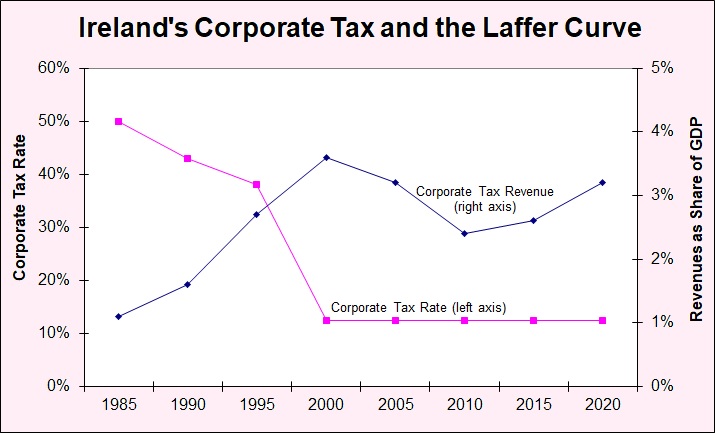
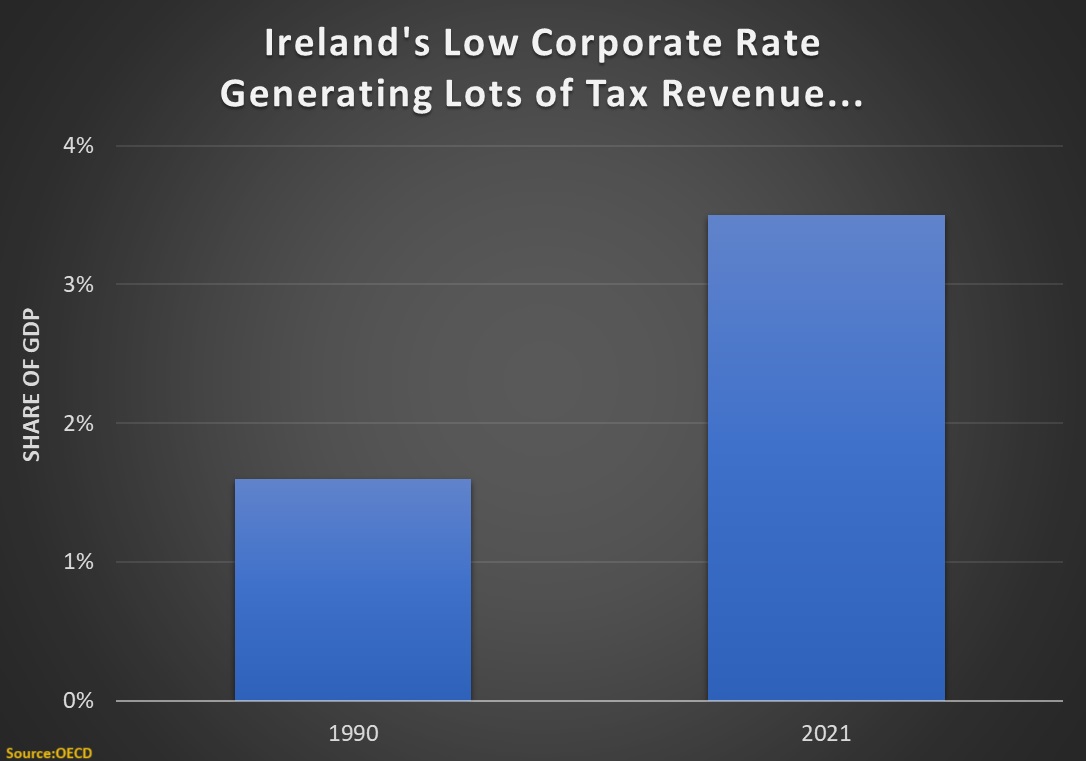
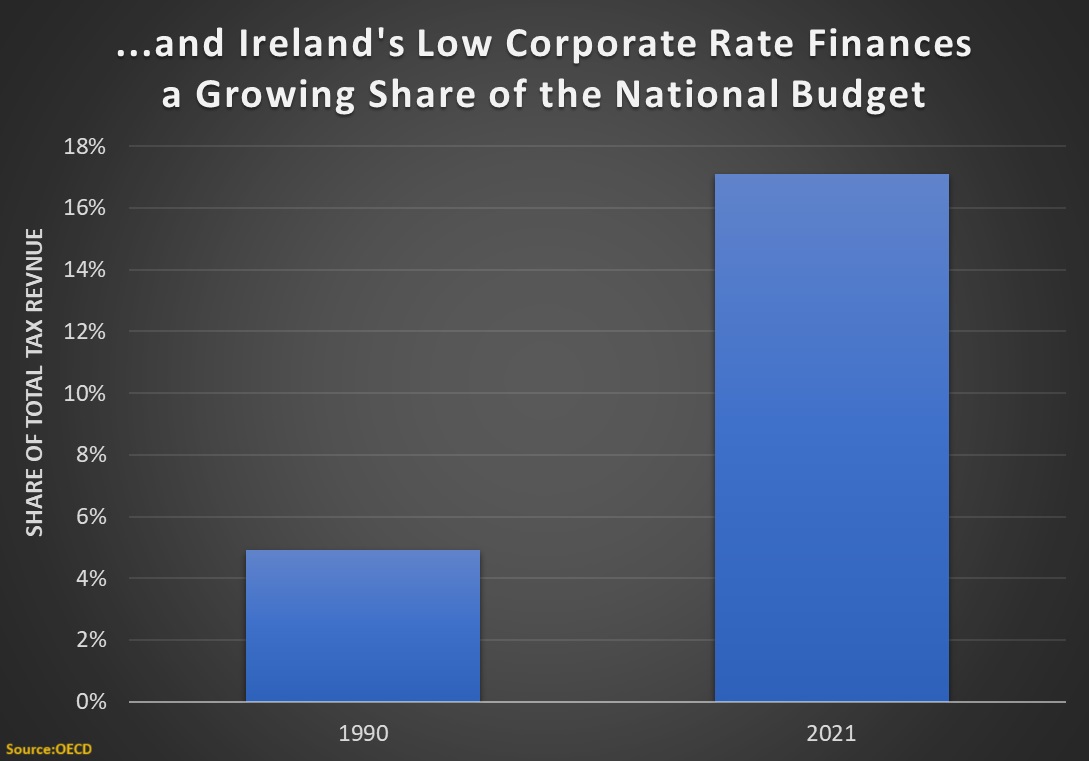
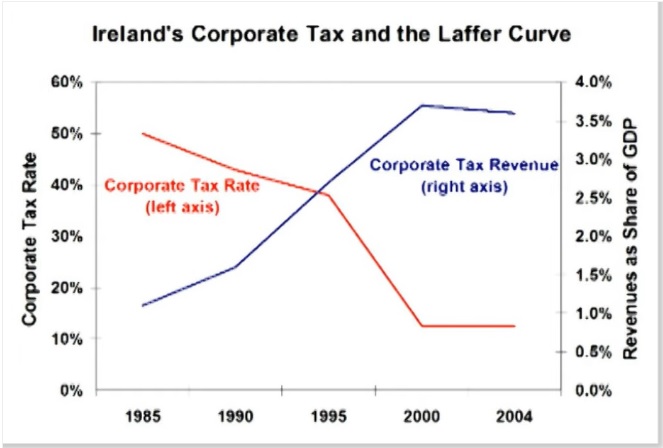
Ireland, by the way, should know better. About the only good policy left in the Emerald Isle is the low corporate tax rate. And as you can see in this video, that policy has yielded very good results.

My favorite example from that video, needless to say, is what happened during the Reagan years, when the rich paid much more to the IRS after their tax rates were slashed.

P.S. You won’t be surprised to learn that a branch of the United Nations is pushing for global taxation of tobacco. To paraphrase Douglas McArthur, “Bad ideas never die, they become global.”

Read Full Post »

Regular readers know that I’m a big advocate of the Laffer Curve, which is the common-sense notion that higher tax rates will cause people to change their behavior in ways that reduce taxable income.

Laffer CurveBut that doesn’t mean “all tax cuts pay for themselves.” Yes, that happened when Reagan lowered tax rates on the “rich” in the 1980s, but there are also tax cuts that generate little or no revenue feedback.

The key thing to understand is that revenue feedback is driven by the degree to which a tax cut leads to more taxable income. And you tend to get bigger changes in taxable income when you lower rates on taxpayers who have considerable control over the timing, level, and composition of their income.

Who are those taxpayers?

Most of us don’t fall in that category. Cutting my tax rate, for instance, probably won’t have much impact on taxable income. My salary from Cato is already established, so there’s not much opportunity for a “supply-side” effect. Every so often I can earn some extra money by writing an article or giving a speech, but (unfortunately!) not enough for it to make a difference even if my incentives are altered.

But investors, entrepreneurs, corporate managers, and small business owners are among those who do have considerable flexibility to respond when incentives change.

Consider this new research from the Tax Foundation, which finds big “supply-side” responses from a lower corporate tax rate. Let’s start with their description of the problem.

The United States currently imposes the highest statutory corporate tax rate in the developed world. …the steep rate discourages U.S. companies from investing as much as they would otherwise and reduces their competitiveness in international markets. …A major barrier to cutting the U.S. corporate tax rate, however, is the reported revenue cost. According to conventional revenue analyses, such as those performed by Congress’s Joint Committee on Taxation (JCT), a lower corporate tax rate would be an expensive revenue loser.

The Tax Foundation then explains why the current revenue-estimating system is misguided.

In reality, the trade-off posited by conventional revenue estimates is misleading. The estimates overstate the revenue cost of cutting the corporate rate and overstate the potential revenue gains from increasing it, because they ignore tax-induced growth effects. Most notably, Congress’s JCT has adopted the static assumption that tax changes have absolutely no impact, for good or ill, on total production, employment, investment, consumption, and other macroeconomic aggregates. …The static assumption has the advantage of simplicity, and it is not too far from the truth for tax changes that either have little impact on incentives at the margin or affect parameters that do not respond much to incentives. This is an extremely unrealistic assumption, however, in the case of the corporate income tax rate.

Bingo. You can click here for more information on why the Joint Committee on Taxation is wrong, and you may be interested to know that fewer than 15 percent of CPAs agree with the JCT’s assumptions.

Using more realistic assumptions, the Tax Foundation calculates the real-world impact of a lower corporate tax rate.

The Tax Foundation’s dynamic simulation model provides quantitative estimates of the growth and revenue effects. The model estimates, for example, that cutting the federal corporate tax rate from 35 percent to 25 percent would raise GDP by 2.2 percent, increase the private-business capital stock by 6.2 percent, boost wages and hours of work by 1.9 percent and 0.3 percent, respectively, and increase total federal revenues by 0.8 percent.

Indeed, they look at a wide range of options and show us “static” estimates based on JCT-type methodology and “dynamic” estimates based on a model that includes changes in taxable income.

Tax Foundation Corporate Tax Revenue-Maximizing Rate

One very important point is that the Tax Foundation looks at the impact of a lower corporate tax rate on all forms of tax revenue.

Federal receipts include many taxes, fees, and payments other than the corporate income tax, such as the personal income tax, payroll taxes, and excises. The size of the economy strongly influences the amounts these taxes, fees, and other payments collect. This is relevant because of the corporate income tax’s big GDP effects. A wide range of federal receipts will expand when a lower corporate income tax rate grows the economy but shrink when a higher corporate income tax downsizes the economic pie.

The study then mentions that the revenue-maximizing corporate tax rate is 14 percent, but warns that this doesn’t mean policy makers should make that their goal.

Although a corporate rate of 14 percent would maximize federal receipts, counting all types of federal revenue, it would not be the optimal rate for the economy unless very little value is placed on people’s incomes and the quantities of goods and services they can consume or invest. The model estimates that while cutting the corporate rate from the revenue-maximizing rate of 14 percent to zero would cost $9 billion of federal revenue, GDP would rise by roughly $300 billion, a payoff of about 33 to 1.

Amen to that point. Our goal isn’t to maximize revenue for the clowns in Washington. The ideal point on the Laffer Curve is where you maximize growth.

If you want my two cents on the topic, you maximize growth when you raise the revenue needed to finance the legitimate functions of government – and that requires a lots less revenue than we’re collecting now according to scholarly evidence on the “Rahn Curve.”

Finally, the Tax Foundation research points out that there’s a difference between the short-run revenue-maximizing rate and the long-run revenue-maximizing rate.

The federal corporate income tax is unusual because the feedbacks there are so strong that cutting the tax’s rate would, over a broad range, more than pay for itself in terms of federal revenues, with the bonus of lifting the incomes and productivity of people throughout the economy. Nevertheless, a corporate rate cut would reduce federal revenues during a transition period, because the rate cut would begin immediately, while it would take several years for the capital stock to expand sufficiently in response to the new incentives to generate the growth needed to return revenues to their prior level.

This chart illustrates this point, using the example of a 25 percent rate.

Tax Foundation Corporate Tax Long-Run Revenue Impact

In other words, the goal of good policy should be to improve the economy’s long-run performance. Over time, that results in more taxable income – a point that even the Congressional Budget Office acknowledges.

The one partial exception to this relationship between good tax policy and long-run tax revenue is the capital gains tax. Lowering that levy can cause big changes to short-run revenue because investors have complete control over when to sell assets. But the reason to lower – or ideally eliminate – that tax is to boost long-run prosperity.

So why aren’t policy makers embracing a lower corporate tax rate? On the right, there should be lots of support because of hostility to high tax rates. And on the left, there should be lots of support because of a desire for more tax revenue. Seems like a match made in Heaven.

But that assumes that folks on the left are motivated by a desire to maximize tax revenue. If you want to know the biggest obstacle to sensible tax policy, pay close attention beginning at the 4:34 mark of this video.

Read Full Post »

All statists want much bigger government, but not all of them are honest about how to finance a Greek-sized welfare state.

The President, for instance, wants us to believe that the rich are some sort of fiscal pinata, capable of generating endless amounts of tax revenue.

Using IRS tax data, I’ve shown that this is a very inaccurate assumption. And I’ve also used IRS data to show the President that there are big Laffer-Curve effects when you try to rape and pillage high-income Americans.

Heck, even the Europeans have realized that you can only squeeze so much blood from that stone.

Notwithstanding the misleading rhetoric from the Obama Administration, there are some honest folks on the left who understand and acknowledge that you can’t have bigger government unless you put ordinary people on the chopping block.

The New York Times seems really fixated on screwing Joe Lunchbucket. Here are some excerpts from an editorial in today’s paper.

…new taxes on high-income Americans are a matter of necessity and fairness; they are also a necessary precondition to what in time will have to be tax increases on the middle class. …As the economy strengthens and the population ages, more taxes will be needed from further down the income scale… But there will never be a consensus for more taxes from the middle class without imposing higher taxes on wealthy Americans, who have enjoyed low taxes for a long time.

What’s particularly interesting about this editorial is that the New York Times is very explicit about political strategy. They support more class-warfare taxes in order to set the stage for higher taxes on the middle class.

We can’t say we haven’t been warned.

Read Full Post »

What’s the revenue-maximizing tax rate?

Since I’m interested in the growth-maximizing tax rate instead, I don’t think that’s even a legitimate question.

That being said, it seems like everyone – both on the left and on the right – should agree that it makes no sense to set tax rates so high that the government loses revenue.

That implies, after all, that the tax system is so punitive that the revenue-raising impact of the higher tax rate is more than offset by the revenue-losing impact of lower taxable income.

But if you ask five economists to identify the revenue-maximizing point, you’ll probably get nine answers.

But one thing we can say for sure is that the revenue-maximizing tax rate on Manny Pacquiao is less than 39.6 percent.

Here are some details from Yahoo Sports.

Manny Pacquiao’s chief adviser insisted Monday that the Filipino superstar’s preference is for his next bout – a fifth fight against Juan Manuel Marquez – to take place away from Las Vegas, with the off-shore Chinese gambling resort of Macau emerging as the “favorite.” The Dec. 8 fight between Manny Pacquiao and Juan Manuel Marquez was held at the MGM Grand in Las Vegas. (AP)Michael Koncz told Yahoo! Sports that the 39.6 percent tax rate Pacquiao would face if he were to fight again in the U.S. makes a fall bout in Las Vegas “a no go.” Promoter Bob Arum…said Pacquiao would not have to pay taxes if the fight takes place in casinos in either Singapore or Macau. “Manny can go back to Las Vegas and make $25 million, but how much of it will he end up with – $15 million?” Arum said. “If he goes to Macau, perhaps his purse will only be $20 million, but he will get to keep it all, so he will be better off.”

This is just an isolated example, to be sure, but I’ve already shared IRS data confirming that the rich have tremendous control over the timing, level, and composition of their income.

And just as is the case with athletes like Pacquiao (and soccer players), wealthy investors and entrepreneurs also have the ability to take advantage of tax competition by shifting economic activity to jurisdictions with better tax policy.

Indeed, these are some of the reasons why upper-income taxpayers wound up paying more money to the IRS after Reagan cut the top tax rate from 70 percent to 28 percent.

Sadly, Barack Obama seems to have a hard time grasping the relationship between tax rates, taxable income, and tax revenue – even though I prepared a simple lesson to help him understand the that there’s not a simplistic linear relationship.

So maybe this short video will help him understand the basic concept of the Laffer Curve.

Then again, maybe the President understands, but just doesn’t care. He’s already stated, after all, that he favors more punitive tax policies even if the government doesn’t collect any extra revenue.

P.S. Just in case you’re not convinced by some IRS data and the experiences of a boxer, there is lots of empirical evidence for the Laffer Curve.

Read Full Post »

Daniel Hannan is a member of the European Parliament from England. He is one of the few economically sensible people in that body, as demonstrated in these short clips of him speaking about tax competition and deriding the European Commission’s corrupt racket.

And as you can see from his latest article in the UK-based Telegraph, he’s also very wise on issues of class warfare tax policy and Laffer Curve responses to punitive taxation.

France’s richest man, Bernard Arnault, is shifting his fortune to Belgium. Gérard Depardieu, the country’s greatest actor (figuratively and literally)is moving to Russia. And, if rumours are to be believed, Nicolas Sarkozy is planning a new career in London. That’s the problem with very high taxes – they don’t redistribute wealth; they redistribute people. …the rich don’t sit around waiting to be taxed. …many financiers can open their businesses abroad simply by opening their laptops. The result of a hike in tax rates is thus often a fall in tax revenue – which means, of course, that the rest of us end up paying more to cover the share of the departed plutocrats.

Hannan understands that rich people have considerable control over the timing, level, and composition of their income, which is precisely why there are powerful Laffer Curve effects when politicians go after the so-called rich (as I tried to explain in a lesson for President Obama).

But Hannan also makes a good point about complexity.

The complexity of a tax system is every bit as damaging to competitiveness as the overall tax rate. The more convoluted the tax code becomes, the more time we have to take off work to comply with it.Tolley’s Tax Handbook is now 11,500 pages long, twice what it was when Gordon Brown became chancellor, and the number of tax lawyers has increased commensurately. …The very wealthy, who can afford ingenious tax advisers and high upfront fees, turn this complexity to their advantage, sheltering their assets in various pockets unintentionally created by government schemes. Again, the rest of us then have to pay more to make up their portion.

Since we have 72,000 pages of complexity and corruption in our tax code, I can’t help but comment that the Brits are lucky that they “only” have 11,500 pages (assuming, of course, that the methodology in both page counts is similar).

In both cases, though, Hannan is right in stating that complexity benefits those who can hire lots of tax lawyers, financial planners, accountants, and other tax advisers.

The answer, of course, is a flat tax. Hannan doesn’t explicitly embrace that option, but he does write about the benefits of lower rates and fewer distortions.

There is one other point he makes that is worth noting. He cites a former Labour Party politician who explicitly was willing to have less prosperity if it meant more equality.

You might, of course, agree with Roy Hattersley, who once said that he’d rather have 5% more equality than 10% more prosperity. That is a respectable position, but at least be honest about it. Wealth taxes create more equal, but poorer societies.

Margaret Thatcher eviscerated that destructive mentality many years ago in this famous speech, but this is an area where proponents of limited government need to do more work.

There are plenty of well-meaning people who mistakenly think the economy is a fixed pie. If we want to help them understand the benefits of small government and free markets, we need to come up with more effective ways of educating them about the important implications of even small differences in economic growth.

I try to make that point in this PBS interview, but I suspect these charts comparing North Korea and South Korea and comparing Chile, Argentina, and Venezuela are much more compelling.

Read Full Post »

I’ve already condemned the foolish people of California for approving a referendum to raise the state’s top tax rate to 13.3 percent.

This impulsive and misguided exercise in class warfare surely will backfire as more and more productive people flee to other states – particularly those that don’t impose any state income tax.

We know that people cross state borders all the time, and it’s usually to travel from high-tax states to low-tax states. And we’ve already seen some evidence that the state’s new top tax rate is causing a loss of highly valued jobs.

This mobility of labor and talent is one of the reasons why California is going to get a very painful lesson about the Laffer Curve.

Politicians (with help from short-sighted voters) can raise tax rates. But they can’t force people to earn income.

Now it looks like one of the super-rich is fed up and looking to make himself less vulnerable to California’s kleptocrats.

Here are some excerpts from an ESPN story.

Phil Mickelson said he will make “drastic changes” because of federal and California state tax increases. …The 42-year-old golfer said he would talk in more detail about his plans — possibly moving away from California or even retiring from golf… Mickelson said. “I’ll probably talk about it more in depth next week. …There are going to be some drastic changes for me because I happen to be in that zone that has been targeted both federally and by the state and, you know, it doesn’t work for me right now. So I’m going to have to make some changes.” …”If you add up all the federal and you look at the disability and the unemployment and the Social Security and the state, my tax rate’s 62, 63 percent,” said Mickelson, who lives in Rancho Santa Fe. “So I’ve got to make some decisions on what I’m going to do.”

He’s actually overstating his marginal tax rate. I suspect it’s closer to 50 percent.

California politicians got too greedy and now they may get 13.3 percent of nothing

But so what? It’s still outrageous and immoral that government is confiscating one-half of the income he generates.

Heck, medieval serfs were virtually slaves, yet they only had to give at most one-third of their output to the Lord of the Manor.

I hope he’s serious and that he escapes from the Golden State’s fiscal hell-hole.

And if he does, what will it mean for California government finances?

Well, here’s what Wikipedia says about his income.

According to one estimate of 2011 earnings (comprising salary, winnings, bonuses, endorsements and appearances) Mickelson was then the second-highest paid athlete in the United States, earning an income of over $62 million, $53 million of which came from endorsements.

Now let’s bend over backwards to make sure we’re not exaggerating. Notwithstanding the Wikipedia estimate, let’s assume his annual taxable income will be only $40 million for 2013 and beyond.

With a 10.3 percent top tax rate, California would collect about $4.12 million per year. And Mickelson apparently thought that was tolerable.

But guess how much the politicians will collect if he leaves the state? I’m tempted to say zero, but they may still get some revenue because of California-based tournaments and other factors.

Find Phil Mickelson

I can say with great confidence, however, that California won’t collect $5.32 million, which is probably what the politicians assumed when they seduced voters into approving the 13.3 percent tax rate.

After all, that assumption only works if Mickelson is willing to be a fiscal slave for Jerry Brown and the rest of the crooks in Sacramento.

As such, I’ll also state with certainty that California’s politicians won’t collect $4 million if Mickelson leaves for another state. Or $3 million. Or $2 million. Or even $1 million.

The best they can hope for is that Mickelson decides to stay in the state while also reducing his taxable income. In that scenario, the politicians might still pocket a couple of million dollars.

Not as much as they collected when the tax rate was 10.3 percent, and far less than what they erroneously assumed they would get with a 13.3 percent rate.

Regardless of Mickelson’s ultimate decision, California is going to be in trouble because most rich people – whether they’re golfers, celebrities, investors, or entrepreneurs – have considerable control over the timing, level, and composition of their income. And they can afford to move.

This is why you don’t want to be on the downward-sloping portion of the Laffer Curve. Everyone’s a loser, both politicians and taxpayers.

So we’re going to see the Laffer Curve get revenge on California and I’ll be first in line to say “serves you right, you blood-sucking parasites.”

If you want more information, here’s my video on the Laffer Curve.

And if you want to watch the full three-part series, they’re all included in this Laffer Curve lesson that I put together for the President. He seems oblivious to real-world evidence, but others may find the information useful.

Read Full Post »

Back in mid-2010, I wrote that Portugal was going to exacerbate its fiscal problems by raising taxes.

Needless to say, I was right. Not that this required any special insight. After all, no nation has ever taxed its way to prosperity.

We’re now at the end of 2012 and Portugal is still saddled with a weak economy. And the higher taxes haven’t resulted in less red ink. Indeed, according to the Economist Intelligence Unit, government debt has jumped from 93 percent of GDP in 2010 to 124 percent of GDP this year.

Why did higher taxes backfire in Portugal? For the same reasons that higher taxes have failed in Greece, Spain, Bulgaria, France, Italy, the United Kingdom, and so many other nations.

  • Higher taxes undermine incentives for productive behavior, thus reducing an economy’s potential for growth. This means less economic output, which also means a smaller tax base. This Laffer Curve effect doesn’t necessarily mean less revenue, but it certainly means that tax increases rarely raise as much money as initially projected.
  • Higher taxes usually are a substitute for the real solution of spending restraint (i.e., Mitchell’s Golden Rule). Politicians oftentimes refuse to reduce the burden of government spending because of an expectation of additional tax revenue. Heck, in many cases, higher taxes trigger an increase in the size and scope of the public sector.

So did Portugal learn any lessons from this failed experiment in Obamanomics?

Hardly. Indeed, the government plans to double down on this approach – even though it’s increasingly apparent that higher tax burdens won’t translate into much – if any – additional tax revenue. Here are some excerpts from a report in the Financial Times.

Lisbon plans to lift income tax revenue by more than 30 per cent, raising the effective average rate by more than a third from 9.8 to 13.2 per cent. Anyone receiving more than the minimum wage of €485 a month, including pensioners, will also pay an extraordinary tax of 3.5 per cent on their income. …the steep tax increases facing many families have made the outlook for 2013 – the third consecutive year of austerity, recession and rising unemployment – the grimmest yet. Total tax revenue has fallen considerably below target this year, forcing the government to implement additional austerity measures… The coalition will be relying on increased state revenue to account for about 80 per cent of the fiscal adjustment required in 2013 – a reversal of the original bailout plan, in which consolidation was to be achieved mainly through spending cuts.

Amazing. The government imposes huge tax hikes, which don’t generate any positive results. Yet even though “tax revenue has fallen considerably below target,” confirming that there are significant Laffer Curve issues, the government chooses to repeat the snake-oil fiscal therapy of higher taxes.

Anybody want to guess what’s going to happen? The answer, of course, is that this will further dampen incentives to generate income and comply with the government’s fiscal demands.

The latest increases have stretched the tax system to the limit, says Carlos Loureiro, a tax partner at Deloitte. “The current model is exhausted. We need to do something different,” he says. “Any further increase in tax rates is unlikely to result in increased revenue.” Income from value added tax, the government’s biggest source of tax revenue representing about 36 per cent of the total, has been falling since 2008, despite a sharp increase in the rate – the main rate is now 23 per cent. Both the government and the European Commission have acknowledged the risks of depending on increased tax revenue, which is more growth sensitive, to meet fiscal targets and contingency spending cuts amounting to 0.5 per cent of national output have prepared in case of another tax shortfall.

I almost want to laugh at the part of the excerpt which notes that tax revenue “has been falling…despite a sharp increase in the rate.”

Maybe it’s time for these fiscal pyromaniacs to realize that revenues might be falling because rates are higher. In other words, Portugal not only isn’t at the ideal point on the Laffer Curve (collecting the amount of revenue needed to finance legitimate activities of government), it may even be past the revenue-maximizing part of the curve.

To be fair, there are lots of factors that determine economic performance, so higher tax burdens are just one possible explanation for why the tax base is shrinking or stagnant.

The one thing we can state with certainty, though, is that Portugal’s fiscal problem is too much government spending. The failure to address this problem then leads to very unpleasant symptoms, such as lots of red ink and self-destructive class-warfare tax policy.

If all that sounds familiar, that’s because it’s also a description of what President Obama is proposing for the United States.

Ummm…shouldn’t they be targeting politicians?

P.S. I don’t want to imply that Portugal is a total basket case. True, I’m not optimistic about the country’s future, but at least some lawmakers now acknowledge that Keynesian spending was a big mistake. And there are even signs that Portuguese officials are beginning to realize that lower tax rates should be part of the solution. But good policy may be impossible since so many people now have a moocher mentality.

P.P.S. At the risk of bearing bad news to close the year, research from both the Bank for International Settlements and the Organization for Economic Cooperation and Development shows the United States actually faces a bigger long-run fiscal challenge than Portugal.

Read Full Post »

Back in September, I shared a very good primer on the capital gains tax from the folks at the Wall Street Journal, which explained why this form of double taxation is so destructive.

I also posted some very good analysis from John Goodman about the issue.

Unfortunately, even though the United States already has a very anti-competitive system – as shown by these two charts, some folks think that the tax rate on capital gains should be even higher.

And it looks like they’re going to succeed, either because we go over the fiscal cliff or because Republicans acquiesce to Obama’s punitive proposal.

But this won’t be good for American competitiveness. Here’s some of what my colleague Chris Edwards just wrote about the issue.

Capital Gains Rates US v OECDNearly every country has reduced tax rates on individual long-term capital gains, with some countries imposing no tax at all. …If the U.S. capital gains tax rate rises next year as scheduled, it will be much higher than the average OECD rate. …Capital gains taxes raise less than five percent of federal revenues, yet they do substantial damage. Higher rates will harm investment, entrepreneurship, and growth, and will raise little, if any, added federal revenue. …Figure 1 shows that the U.S. capital gains tax rate of 19.1 percent in 2012 is higher than the OECD average rate of 16.4 percent.  These figures include both federal and average state-level tax rates on long-term capital gains. Next year, the expiration of the Bush tax cuts will push up the U.S. rate by 5 percentage points, and the new investment tax imposed under the 2010 health care law will push up the rate another 3.8 percent. As a result, the top U.S. capital gains tax rate will be 27.9 percent, which will be far higher than the OECD average. The federal alternative minimum tax and other provisions can increase the U.S. capital gains tax rate even higher.

The worst country is Denmark, at 42 percent, followed by France (32.5 percent), Finland (32 percent), Sweden and Ireland (both 30 percent), and the United Kingdom and Norway (both 28 percent).

Every other developed nations will have a capital gains tax rate below the United States level. And even some of those above the U.S. level often have provisions that spare many taxpayers from this pernicious form of double taxation.

Some countries have exemptions for smaller investors. In Britain, for example, individuals can exempt from tax the first $17,000 of capital gains each year. Eleven OECD countries do not impose taxes on longterm capital gains, nor do some jurisdictions outside of the OECD, such as Hong Kong, Malaysia, and Thailand.

The nations on the list that don’t tax capital gains are Belgium, Czech Republic, Greece, Luxembourg, Mexico, Netherlands, New Zealand, Slovenia, South Korea, Switzerland, and Turkey.

I’m not surprised to see Switzerland on that list since that nation has some very sensible fiscal policies. And the Netherlands, notwithstanding its welfare state and long-run fiscal challenges, is very focused on global competitiveness.

But who would have thought Greece had any good policies?!? Or Belgium? Though maybe that’s one of the reasons why many successful French taxpayers are choosing that nation as a refuge.

Heck, even Russia has abolished its capital gains tax.

In his paper, Chris also gives a good explanation of the underlying tax theory in the capital gains tax debate. Simply stated, the statists like the “Haig-Simons” approach because it justifies class-warfare tax policy.

To maximize growth, we should “tax the fruit of the tree, but not the tree itself.” That is, we should tax the flow of consumption produced by capital assets, not the capital that will provide for future consumption. A Haig-Simons tax base—which includes capital gains—taxes the tree itself.  Why does a Haig-Simons tax base garner support if it is impractical and anti-growth? It appears to be because the liberal idea of “fairness” includes heavy taxation of high earners. Since high earners save more than others, they would be taxed heavily under a Haig-Simons tax base. …Today, many economists favor shifting from an income to a consumption tax base… Under a consumption tax base, savings would not be double-taxed, and capital gains would not face separate taxation because the cashflow from realized gains would be taxed when consumed. With regard to “fairness,” a Haig-Simons tax base penalizes frugal people and rewards the spendthrift. That’s because earnings are taxed a second time when saved, while immediate consumption does not face a further tax. That makes no sense because it is frugal people—savers—who are the benefactors of the economy since their funds get invested in the new businesses and new capital equipment that generates growth.

The right approach is to have a “consumption tax base,” which simply is another way of saying that income shouldn’t be taxed more than one time (as shown in this flowchart).

My video elaborates on all these issues and explains why the right capital gains tax rate is zero.

Writing about the death tax yesterday, I mentioned that it also is a perverse form of double taxation. And just as with the death tax, it’s worth noting that all the major pro-growth tax reform plans  – such as the flat tax or national sales tax – also have no capital gains tax.

It’s bad enough when the IRS gets to tax our income one time. They shouldn’t be allowed more than one bite of the apple.

P.S. Chris makes a very important point about higher capital gains taxes collecting little, if any revenue. Simply stated, there’s a large Laffer Curve effect since investors can choose not to sell an asset if the tax penalty is too high.

Read Full Post »

Like most people, I’m a sucker for a heartwarming story around the holidays.

Sometimes, you get that nice feeling when good things happen to good people, like you find at the end of a classic movie like “It’s a Wonderful Life.”

But since I’m a bit of a curmudgeon, I also feel all warm and fuzzy when bad things happen to bad people.

That’s why I always smile when I read stories about taxpayers moving across borders, thus preventing greedy tax-hiking politicians from collecting more revenue.

“Where’s our tax revenue?!?”

I’m glad when that happens to French politicians. I’m glad when it happens to Italian politicians. I’m glad when it happens to Illinois politicians. And British politicians. And Spanish politicians. And Maryland politicians. I could continue, but I think you get the point.

I’m even glad when it happens to the politicians in Washington.

I smile because I envision the moment when some budget geek tells these sleazy politicians that projected revenues aren’t materializing and they don’t have more money to spend.

So I wish I could be a fly on the wall when this moment of truth happens to California politicians. They convinced voters in the state to enact Prop 30, a huge tax increase targeting those evil, awful, bad rich people.

Governor Brown and his fellow kleptocrats in Sacramento doubtlessly are salivating at the thought of more money to waste.

But notwithstanding a satirical suggestion from Walter Williams, there aren’t guard towers and barbed-wire fences surrounding the state. Productive people can leave, and that’s happening every day. And they take their taxable income with them.

Usually in ways that don’t attract attention. But sometimes a bunch of them leave at the same times, and that is newsworthy. Here’s an example of that happening, as reported by the San Francisco Chronicle.

Chevron Corp. will move up to 800 jobs – about a quarter of its current headquarters staff – from the Bay Area to Houston over the next two years but will remain based in San Ramon, the oil company told employees Thursday. …The company already employs far more people in Houston – about 9,000 full-time employees and contractors – than it does in San Ramon.

We don’t know a lot of details, but these were positions at the company’s headquarters and they were “technical positions dealing with information and advanced energy technologies…tied to Chevron’s worldwide oil exploration and production business.”

Let’s assume these highly skilled employees earn an average of $250,000. I imagine that’s a low-ball estimate, but this is just for purposes of a thought experiment. Now multiply that average salary by 800 workers and you get $200 million of income.

And every penny of that $200 million no longer will be subject to tax by the kleptocrats in the state’s capital.

In other words, we’re seeing the Laffer Curve in action.

Politicians can raise tax rates all day long, but that doesn’t automatically translate into more tax revenue. Politicians keep forgetting that taxable income is not a fixed variable.

What’s happening in a big way with Chevron is happening in small ways every single day with investors, entrepreneurs, small business owners, and other “rich’ people.

That’s good for the people escaping. And it also will warm my heart when California’s despicable politicians discover next year that there’s an “unexpected” revenue shortfall.

P.S. It’s just an anecdote that the Chevron jobs are going to Texas. But when you add together a bunch of anecdotes, you get data. And according to the data, Texas is kicking the you-know-what out of California. Maybe there’s a lesson to be learned?

Read Full Post »

Another Frenchman has “gone Galt.”

First, it was France’s richest entrepreneur.

Now, it’s the nation’s most famous actor. Gerard Depardieu has officially announced – in a letter to France’s thuggish Prime Minister – that he is tired of paying 85 percent of his income to finance the vote-buying actions of France’s kleptocratic political elite.

Instead, he is going to move to Belgium (which is hardly a tax haven, but there’s an old line about how you should surround yourself with fat people if you want to look skinny).

Here are some of the amusing details from the UK-based Telegraph.

DepardieuThe French actor whose eccentric personality has come to symbolise a certain, old fashioned form of Gallic love for good food and the pleasures in life, also known as a “bon vivant,” said he is finished with the country, in a letter published in the Journal du Dimanche.It is addressed to Jean-Marc Ayrault, the French prime minister, who called Depardieu “pathetic” for wanting to move just over the French border to the wealthy Belgian town of Néchin, where he will evade the current Left-leaning government’s tax hikes.”I am handing over to you my passport and social security, which I have never used,” he said. …The actor asserts he has always been an upstanding citizen, deserving “respect,” and who has employed 80 people, always paid his taxes, and “never killed anybody.” He said he paid 85 per cent of his income in taxes in 2012, and over 45 years, has paid 145 million Euros – or £118 million – in taxes. …”I leave because you consider that success, creation, talent, difference, in fact, should be sanctioned,” he writes.

Gee, why is Depardieu complaining? In an act of generosity and mercy, France’s President has said he doesn’t want anybody to pay more than 80 percent of their income to the state. So if Gerard is paying 85 percent this year, he’ll get a tax cut!

Methinks that Depardieu doesn’t trust Hollande, Ayrault, and the rest of the thieves. In any event, it’s obvious – and understandable – that he resents the French government’s attack on “success, creation, talent.”

So we’re going to see the Laffer Curve in action. Depardieu has pad nearly $200 million to the French tax authorities over the past several decades. Now that the French government has tightened the screws even further, he’s going to pay them a lot less.

Maybe there’s a lesson there for Obama. But I’ve already tried to educate our taxer-in-chief about these issues, so I doubt this new evidence from France will make any difference.

“Dan, you are such a giver!”

P.S. Going Galt is a bit of a national pastime in France. In 1999, Laetitia Casta was chosen to be “Marianne,” the symbol of France. A couple of years later, as my friend Veronique de Rugy wrote, she decided to move to the United Kingdom to escape confiscatory taxation.

Because I’m a selfless person and a bit of an expert on tax havens, I hereby offer Laetitia my services to help with her tax planning.

I’m even willing to work 24/7 to help her protect her earnings, even if it requires an overnight stay.

No sacrifice is too great, after all, to help the cause of freedom.

Read Full Post »

Atlas is shrugging and Dan Mitchell is laughing.

I predicted back in May that well-to-do French taxpayers weren’t fools who would meekly sit still while the hyenas in the political class confiscated ever-larger shares of their income.

But the new President of France, Francois Hollande, doesn’t seem overly concerned by economic rationality and decided (Obama must be quite envious) that a top tax rate of 75 percent is fair.” And patriotic as well!

French Prime Minister: “I’m upset that the wildebeest aren’t remaining still for their disembowelment.”

So I was pleased – but not surprised – when the news leaked out that France’s richest man was saying au revoir and moving to Belgium.

But he’s not the only one. The nation’s top actor also decided that he doesn’t want to be a fatted calf. Indeed, it appears that there are entire communities of French tax exiles living just across the border in Belgium.

Best of all, the greedy politicians are throwing temper tantrums that the geese have found a better place for their golden eggs.

France’s Prime Minister seems particularly agitated about this real-world evidence for the Laffer Curve. Here are some excerpts from a story in the UK-based Telegraph.

“No fair!”

France’s prime minister has slammed wealthy citizens fleeing the country’s punitive tax on high incomes as greedy profiteers seeking to “become even richer”. Jean-Marc Ayrault’s outburst came after France’s best-known actor, Gerard Dépardieu, took up legal residence in a small village just over the border in Belgium, alongside hundreds of other wealthy French nationals seeking lower taxes. “Those who are seeking exile abroad are not those who are scared of becoming poor,” the prime minister declared after unveiling sweeping anti-poverty measures to help those hit by the economic crisis. These individuals are leaving “because they want to get even richer,” he said. “We cannot fight poverty if those with the most, and sometimes with a lot, do not show solidarity and a bit of generosity,” he added.

In the interests of accuracy, let’s re-write Monsieur Ayrault’s final quote from the excerpt. What he’s really saying is: “We cannot buy votes and create dependency if those that produce, and sometimes produce a lot, do not act like morons and let us rape and pillage without consequence.”

So what’s going to happen? Well, I wrote in September that France was going to suffer a fiscal crisis, and I followed up in October with a post explaining how a bloated welfare state was a form of economic suicide.

Yet French politicians don’t seem to care. They don’t seem to realize that a high burden of government spending causes economic weakness by misallocating labor and capital. They seem oblivious  to basic tax policy matters, even though there is plenty of evidence that the Laffer Curve works even in France.

So as France gets ever-closer to fiscal collapse, part of me gets a bit of perverse pleasure from the news. Not because of dislike for the French. The people actually are very nice, in my experience, and France is a very pleasant place to visit. And it was even listed as the best place in the world to live, according to one ranking.

But it helps to have bad examples. And just as I’ve used Greece to help educate American lawmakers about the dangers of statism, I’ll also use France as an example of what not to do.

P.S. France actually is much better than the United States in that rich people actually are free to move across the border without getting shaken down with exit taxes that are reminiscent of totalitarian regimes.

P.P.S. This Chuck Asay cartoon seems to capture the mentality of the French government.

Read Full Post »

Obama’s main goal in the fiscal cliff negotiations is to impose a class-warfare tax hike.

He presumably thinks this will give the government more money to spend, but recent evidence from the United Kingdom suggests that he won’t get nearly as much money as he thinks.Laffer Curve

Why? Because there’s this thing called the Laffer Curve. It shows that it is naive to believe that there is a linear relationship between tax rates and tax revenue. To accurately predict what will happen to revenues when there is a change in tax policy, you also have to estimate what will happen to taxable income.

And when you’re trying to stick it to the “rich,” you need to understand that they have tremendous control over the timing, level, and composition of their income. So unlike the rest of us, they can respond very easily when the government goes after them.

The Wall Street Journal opines on what recently happened across the Atlantic.

A funny thing often happens on the way to soaking the rich: They don’t stick around for the bath. Take Britain, where Her Majesty’s Revenue and Customs service reports that the number of taxpayers declaring £1 million a year in income fell by more than 60% in fiscal 2010-2011 from the year before. That was the year that millionaires became liable for the 50% income-tax rate that Gordon Brown’s government introduced in its final days in 2010, up from the previous 40% rate. Lo, the total number of millionaire tax filers plunged to 6,000 in 2010-2011, from 16,000 in 2009-2010. The new tax was meant to raise about £2.5 billion more revenue. So much for that. In 2009-2010 British millionaires contributed about £13.4 billion to the public coffers, or just under 9% of the total tax liability of all taxpayers that year. At the 50% rate, the shrunken pool yielded £6.5 billion, or about 4.4%.

In case you think this is just a special case, the United States conducted a similar experiment in the 1980s, except we lowered tax rates instead of raising them. And as you can see in this “lesson” post I wrote for the President, we got the same results as the United Kingdom, except in reverse. More rich people, more taxable income, and more tax revenue.

Here’s a chart showing what happened in the U.K. It shows tax revenue for the 2009-2010 fiscal year, followed by a projection for 2010-2011, and then the real-world numbers.

UK Laffer Curve

Now time for some important caveats. There are lots of things that determine taxable income for the rich, so we have no way of precisely knowing the extent to which the higher tax rate caused taxable income – and therefore tax revenue – to fall. The economy’s weak performance may have played a role, though the recession in the U.K. occurred in 2008 and 2009, so you would expect taxable income to climb for the 2010-2011 fiscal year.

It’s also possible that some of the revenue loss was the result of income shifting rather than a genuine decline in the amount of economic activity.

But we do know that the same pattern keeps appearing in nation after nation, whether we’re looking at Italy, France, or Spain. Or states such as IllinoisOregonFlorida, Maryland, and New York.

You mess with the Laffer Curve and it will get its revenge.

Read Full Post »

President Obama and other statists in Washington want a big class-warfare tax hike. They claim the additional revenue is necessary to reduce red ink.

But their ideological crusade is based on some blatant distortions.

In other words, the Obama tax hike will make government bigger, even if some naively support the tax hike because they want smaller deficits.

That being said, I’m not overly optimistic that Obama’s divisive proposal can be stopped, largely because I don’t think Republicans will take my advice on how to win this fight.

But at least the American people have an appropriately jaundiced view about what will happen if Obama does prevail.

Here are the results of a recent poll showing that a strong majority understand that more revenue will lead to an expansion in the burden of government spending.

Though I suppose these numbers don’t necessarily show that people are against higher taxes. Perhaps some of the 57 percent want higher taxes because they want more government.

After all, that’s the most logical interpretation of the election results in California, where voters approved a referendum to rape and pillage upper-income taxpayers.

But I suspect – and definitely hope – that most of the 57 percent understand that making America more like Europe is not a desirable outcome.

By the way, I shared some polling data last week showing that CPAs think that changes in tax rates lead to substantial Laffer Curve effects.

They were also asked their opinion on whether higher taxes will be used for deficit reduction.

As you can see, they were even more skeptical than the general public, with more than 60 percent definitely thinking that more revenue in Washington will lead to more spending.

To be sure, there’s no particular reason to think that CPAs have any special insight on this issue. On the Laffer Curve question, by contrast, they presumably do have insider knowledge of how taxpayers respond when tax policy changes.

But I’m digressing. The point of this post is to explain that higher taxes will lead to bigger government.

And if you don’t believe me, then why did the New York Times unintentionally admit that the only budget deal that actually resulted in a budget surplus was the one that cut taxes instead of raising them?

Read Full Post »

Remember when you were a kid and your parents would either be happy or angry depending on whether your report card said you were trying hard or being a slacker? No matter whether your grades were good or bad, it helped to get an “A for Effort.”

But sometimes a high level of effort isn’t a good thing.

The World Bank has a new study that measures national tax burdens. But instead of using conventional measures, such as top tax rates or tax collections as a share of GDP, the international bureaucracy has developed an index that measures “tax effort” and “tax capacity” after adjusting for variables such as per-capita GDP, corruption, and demographics.

One goal of the study is to develop an apples-to-apples way of comparing tax burdens for nations at various levels of development. Poor nations, for instance, tend to have low levels of tax revenue even though they often have high tax rates. This is partly because of Laffer Curve reasons, but perhaps even more so because of corruption and incompetence. Rich nations, by contrast, usually have much greater ability to enforce their tax codes. So if you want to compare the tax system of Paraguay with the tax system of Sweden, you need to take these factors into account.

Here’s a description of how the authors addressed this issue.

Measuring taxation performance of countries is both theoretically and practically challenging. …tax economists have attempted to deal with this problem by applying an empirical approach to estimate the determinants of tax collection and identify the impact of such variables on each country’s taxable capacity. The development of a tax effort index, relating the actual tax revenues of a country to its estimated taxable capacity, provides us with a tempting measure which considers country specific fiscal, demographic, and institutional characteristics. …Tax effort is defined as an index of the ratio between the share of the actual tax collection in GDP and the taxable capacity.

This is a worthwhile project. There sometimes are big differences between nations and those should be part of the equation when comparing tax policies. Indeed, this is why my recent post on the rising burden of the value-added tax looked at data for nations at different levels of development.

But I’m irked by the World Bank study because it’s really measuring “tax onerousness.” I’m not even sure onerousness is a word, but I sure don’t like the term “tax effort” because it implies that a higher tax burden is a good thing. After all, we learned from our report cards that it’s good to demonstrate high effort and not be a slacker.

And just so you know I’m not just imagining things, the authors explicitly embrace the notion that bigger tax burdens are desirable. They assert (without any evidence, of course) that higher levels of tax promote “development” and that more money for politicians is “desirable.”

The international development community is increasingly recognizing the centrality of effective taxation to development. …higher tax revenues are important to lower the aid dependency in low-income countries. They also encourage good governance, strengthen state building and promote government accountability. …many developing countries experience a chronic gap between the actual and desirable levels of tax revenues. Taxation reforms are needed to close this gap.

If the authors of the study looked at economic history, they would understand that they have things backwards. “Effective taxation” doesn’t lead to “development.” It’s the other way around. The western world became rich when the burden of government was very small and most nations didn’t even have income tax regimes. It was only after nations because prosperous that politicians figured out how to extract significant shares of economic output.

But let’s set that aside and see which nations have the most and least onerous tax systems. Here’s a table from the report and it seems that Papua New Guinea has the world’s worst tax system and Bahrain has the best tax system. Among developed nations, New Zealand is the worst and Japan is the best. The United States (circled in red) gets a decent score. We’re not nearly as good as Switzerland and we’re slightly worse than Canada, but our politicians expend less “effort” than their counterparts in nations such as France, Italy, and Belgium.

By the way, I’m not endorsing either the methodology or the results. I like what the authors are trying to do (at least in terms of creating an apples-to-apples measure), but some of the results seem at odds with reality. New Zealand’s tax system isn’t great, but it certainly doesn’t seem as bad as the French tax code. And I have a hard time believing that Japan’s tax code is less onerous than the Swiss system.
The World Bank study also breaks down the data so that countries can be put into a matrix based on how much money they collect and how much “effort” they expend.

Here’s where the authors let their bias show. In their descriptions of the various boxes, they reflexively assume that higher tax collections are a good thing. Here is some of what they wrote in that section of the study.

The collection of taxes in this group of countries is currently low and lies below their respective taxable capacity. These countries have potential to succeed in deepening comprehensive tax policy and administration reforms focusing on revenue enhancement. …Botswana and Chile were originally in the low-effort, low-collection group, but they made it to the high-effort, high-collection group after recent improvements in revenue performance. …Although countries in this [high collection, low effort] group have already achieved a high tax collection, fiscally they still have the potential to implement reforms to reduce distortions and reach a higher level of efficiency of tax collection, since their tax effort index is low.

Very Orwellian, wouldn’t you say? We’re supposed to conclude that it’s bad if nations are “below their respective taxable capacity” because they can “succeed in deepening comprehensive tax policy” for purposes of “revenue enhancement.” Other nations, though, got gold stars because of “improvements in revenue performance.” And others were encouraged to try harder, even if they already collected a lot of revenue, in order to “reach of a higher level of efficiency of tax collection.”

But, to be fair, the study does include some semi-sensible comments acknowledging that there are limits to the greed of the political class. For all intents and purposes, the authors warn that there will be Laffer Curve effects if “high effort” nations seek to make their tax systems even more onerous.

Given that the level of tax intake in this group of countries is already high and stays above their respective taxable capacity, a further increase in tax revenue collection may lead to unintended economic distortions. …low-income countries with a low level of tax collection but high tax effort have less opportunity to increase tax revenues without possibly creating distortions or high compliance costs.

Just in case you’re not familiar with the lingo, “distortion” refers to the economic damage caused by high tax rates. This can be because high tax rates lead to a reduction in work, saving, investment, entrepreneurship, and other productive behaviors. Or it can be because high tax rates encourage people to make economically inefficient choices solely for tax planning purposes.

So the fact that the World Bank recognizes that taxes can hurt economic performance in at least some circumstances puts them ahead of the Congressional Budget Office and Joint Committee on Taxation. That’s damning with faint praise, to be sure, but I wanted to close on an upbeat note.

P.S. If you peruse the matrix, you’ll notice that New Zealand is considered a developing country. I’m sure that will be the source of amusement to my friends in Australia.

Read Full Post »

If there was a prize for fighting back against tax authorities, the Italians would probably deserve first place. I’m not aware of any other country where tax offices get firebombed. The Italians also believe in passive forms of resistance, with tens of thousands of boat owners sailing away to protect themselves from the government.

But the Spanish are beginning to get into the swing of things, perhaps because they are increasingly upset by the plethora of tax hikes imposed by the supposedly right-of-center government in Madrid.

Here’s part of a report from NPR about a new tax revolt on the Iberian Peninsula.

When the Spanish government hiked sales tax on theater tickets this past summer, Quim Marcé thought his theater was doomed. With one in four local residents unemployed, Marcé knew that even a modest hike in ticket prices might leave the 300-seat Bescanó municipal theater empty.

So what did he do to protect the theater from fiscal destruction?

Taxes are revolting, so why aren’t you?

“We said, ‘This is the end of our theater, and many others.’ But then the next morning, I thought, we’ve got to do something, so that we don’t pay this 21 percent, and we pay something more fair,” says Marcé in Spanish. …He…suddenly had an idea: Instead of selling tickets to his shows, he’d sell carrots. “We sell one carrot, which costs 13 euros [$16] -– very expensive for a carrot. But then we give away admission to our shows for free,” he explains in Spanish. “So we end up paying 4 percent tax on the carrot, rather than 21 percent, which is the government’s new tax rate for theater tickets.” Classified as a staple, carrots are taxed at a much lower rate and were spared new tax hikes that went into effect here on September 1.

Very clever. Senor Marcé is getting lots of praise for his novel approach, though it’s unclear whether the ravenous tax bureaucrats will come up with some sort of ruling to squash the tax revolt.

Spanish media have dubbed this the “Carrot Rebellion,” and the Bescanó theater has won kudos from arts advocates nationwide. Shows are sold out. …Marcé, the theater director, says he consulted a lawyer before launching his carrot sales. He’s got backing from the local mayor too. And no one has stopped him so far. …He says he’s a little worried the government might declare it illegal to sell carrots at theaters. But dozens of foods are considered “staples” and taxed at only 4 percent. So if that happens, Marcé says he might switch to selling tomatoes instead.

And if he has some leftover tomatoes that are rotten, perhaps they can be used – along with spoiled eggs and moldy cabbage – to express appreciation for any tax collectors that happen to visit (I won’t say what the carrots can be used for).

So why doesn’t the title of this post award “three cheers” for this Spanish tax revolt?

Well, as much as I admire non-compliance when tax systems are too onerous, I suspect that these Spaniards are protesting against the idea that they should pay for big government, but I wouldn’t be surprised to learn that they very much support a bloated welfare state if someone else is picking up the tab.

In other words, they’re probably hypocrites, and I wouldn’t be shocked to learn that their Irish and Greek compatriots also are protesting for the wrong reason.

Moreover, it’s not specified in the article, but I’m quite certain that the Spaniards actually are protesting in favor of tax distortions. The 4 percent tax on carrots and other “staples” presumably is a special exception to the normal value-added tax of 21 percent.

If they were protesting the VAT, I would give them three cheers, but if they’re simply protesting the fact that theater tickets are now treated the same as most other forms of consumption, then I’m tempted to give this tax revolt only one cheer.

But I’ll still give them two cheers because I’m in favor of just about anything that will reduce the amount of money diverted to finance government.

That’s because the real fiscal problem, in Spain and the United States, is that government is far too big. And trying to curb the rapacious appetites of politicians with a tax hike is akin to trying to cure a group of alcoholics by giving them the keys to a liquor store.

P.S. The greedy Spanish government may have jacked up some tax rates so high that they could be beyond the revenue-maximizing point, though I doubt the politicians care. Heck, even international bureaucracies such as the IMF have figured out that it’s self-destructive to push tax rates so high that governments lose revenue.

P.P.S. Just to cover my you-know-what, allow me to take this opportunity to stress that maximizing revenue should not be the goal of tax policy. I’m a big fan of the Laffer Curve, to be sure, but policy makers should target the growth-maximizing point.

Read Full Post »

I’m a big believer in the Laffer Curve, which is the common-sense proposition that changes in tax rates don’t automatically mean proportional changes in tax revenue. This is because you also have to think about what happens to taxable income, which can move up or down in response to changes in tax policy.

The key thing to understand is that incentives matter. If you raise tax rates and therefore increase the cost the engaging in productive behavior, people will be less likely to work, save, invest, and be entrepreneurial. And they’ll figure out ways to engage in tax avoidance and tax evasion to protect the interests of their families. In other words, taxable income will be lower because of higher tax rates.

Likewise, people will be more willing to earn – and report – taxable income if tax rates are reduced.

If you don’t believe me, look at this incredible data showing how the rich paid for more money after Reagan slashed their tax rates.

This doesn’t mean that “tax cuts pay for themselves.” That may happen in rare circumstances, but the real issue is the degree of “revenue feedback.”

For some types of tax changes, such as lowering tax rates on the “rich,” the revenue feedback may be very large because they have considerable control over the timing, level, and composition of their income.

In other cases, such as providing a child tax credit, the feedback may be very small because there’s not much of an impact on incentives to engage in productive behavior.

This doesn’t necessarily mean one type of tax cut is good and the other bad. It just means that some changes in tax policy produce revenue feedback and others don’t.

Even leftists recognize there is a Laffer Curve. They may argue that the “revenue-maximizing rate” is very high, with some claiming the government can impose tax rates of more than 70 percent and still collect additional revenue. But they all recognize that there’s a point where revenue-feedback effects are so strong that higher rates will lose revenue.

Actually, let me rephrase that assertion. There is a small group of people in the nation who claim that there’s no Laffer Curve. But that’s no surprise, the world is filled with weird people. Some genuinely think the world is flat. Some think the moon landings were faked. You can probably find some people who actually think the sun is a giant candle in the sky.

But what is surprising is that this small cadre of anti-Laffer Curve fanatics are at the Joint Committee on Taxation, which is the group on Capitol Hill in charge of providing revenue estimates on tax legislation.

They aren’t completely oblivious to the real world. They do acknowledge some “micro” effects of changes in tax rates, such as people shifting between taxable and non-taxable forms of compensation. But they completely reject “macro” changes such as changes in economic growth and employment.

So if we replaced the nightmarish income tax with a simple and fair flat tax, the JCT would assume no impact of GDP or jobs. If we went the other direction and doubled all tax rates, the JCT would blithely assume no change to the economy.

To give you an idea of why this is an extreme view, I want to share some polling data. Last week, I spoke at the national conference of the American Institute of Certified Public Accountants.  As you can imagine, this is a crowd that is very familiar with the internal revenue code. They know the nooks and crannies of the tax code and they have a good sense of how clients respond when tax policy changes.

Prior to my remarks, the audience was polled on certain tax issues.

Some of the answers disappointed me. By a narrow margin, the crowd thought it would be a good idea if the overall tax burden increased. But here’s the response that fascinated me the most. The audience was asked what could be described as a Laffer Curve question. Specifically, they were asked, “Do you believe the growth potential of marginal tax rate cuts could lead to some degree of revenue feedback, even if not enough to be self-financing?”

They had four possible responses. Here’s the breakdown of their answers.

These are remarkable results. A plurality (more than 36 percent) think the Laffer Curve is so strong that lower tax rates are self-financing. Even I don’t think that’s the case. Another 23.5 percent of respondents think there are very significant feedback effects, meaning that lower tax rates don’t lose much money.

There were also 18.6 percent who thought there were some Laffer Curve effects, though they thought the revenue feedback wasn’t very significant.

Less than 15 percent of the crowd, however, agreed with the Joint Committee on Taxation and said that lower tax rates have no measurable revenue feedback.

Why am I sharing this information? Well, we’re going to have a big debate in the next month or two about President Obama’s proposed class-warfare tax hike on investors, entrepreneurs, small business owners, and other rich people.

Supporters of that approach will cite Joint Committee on Taxation numbers to claim that the tax hike will generate a big pile of money.

That number will be based on nonsensical and biased methodology. In an ideal world, opponents will mock that number and expose the JCT’s primitive approach.

For additional information, here’s Part III of my video series on the Laffer Curve, exposing the role of the Joint Committee on Taxation.

If you want to see Parts I and II, click here.

Read Full Post »

I’m not a big fan of the International Monetary Fund, largely because the folks in charge oftentimes advocate toxic policies such as bailouts, higher taxes, and currency devaluation.

But there are some top-rate economists working at the IMF, and the bureaucracy has published some good studies about the economic benefits of reducing government spending and others warning that tax increases can be self defeating (by the way, too bad we can’t get the Joint Committee on Taxation to also acknowledge the Laffer Curve).

Now the IMF has a new study about the relationship between economic growth and different types of taxes. Those finding are interesting, and I may even write about them in the next few days, but I want to focus on some amazing data from this research that shows exactly why proponents of limited government should resist the value-added tax.

These charts are taken from page 10 of the IMF study and they depict changes, over the past several decades, for both personal income tax (PIT) revenues and consumption tax revenues, both measured as a share of economic output. The charts are divided to show trends in low-income countries, middle-income countries, and high-income countries.

These are remarkable numbers. They basically show that politicians have been unable to squeeze more money out of the income tax. We don’t know if that’s because of the Laffer Curve, tax competition, electoral resistance, or all of the above. But we can say with considerable confidence that the income tax has not been a money machine over the past 40 years.

I’m not saying it’s a good tax. Far from it. The income tax is unfair. It’s punitive. It’s discriminatory. It’s corrupt. And, when it was first adopted, it did generate a big new pile of revenue for the politicians.

But that was 100 years ago. In recent decades, by contrast, it hasn’t been a piggy bank for statists seeking to expand the burden of government spending.

The data for the VAT and other consumption taxes, by contrast, shows just the opposite. With each passing decade, the VAT burden climbs, and that’s true for nations at all stages of development.

This is one of the reasons why a VAT would be a disaster for the United States. Politicians might make promises about repealing or reducing other taxes in exchange for a VAT, but it is a 99-percent certainty that politicians would pull a bait-and-switch. We’d still be stuck with the awful income tax system and the IRS, but the crooks and clowns in Washington would have a new source of revenue to feed their spending addiction.

Isn’t that wonderful? We’d be taxed when we earn our income (often more than one time), and then taxed again when we spend our income. Just like Europe.

Here’s my video explaining why a value-added tax would be a fiscal disaster.

One final point. I don’t care if you like Mitt Romney or dislike Mitt Romney. But, given his less-than-sound views on the VAT, I want everybody to be prepared to hold his feet to the fire if he happens to prevail on November 6.

P.S. You’ll be delighted to learn that the pampered bureaucrats at the IMF get tax-free salaries, just like their cousins at the OECD and the rest of the international bureaucracies.

P.P.S. I just shared these a few days ago, but if you didn’t get a chance to see them, you can enjoy some good anti-VAT cartoons herehere, and here.

Read Full Post »

The folks at the Center for Freedom and Prosperity have been on a roll in the past few months, putting out an excellent series of videos on Obama’s economic policies.

Now we have a new addition to the list. Here’s Mattie Duppler of Americans for Tax Reform, narrating a video that eviscerates the President’s tax agenda.

I like the entire video, as you can imagine, but certain insights and observations are particularly appealing.

1. The rich already pay a disproportionate share of the total tax burden – The video explains that the top-20 percent of income earners pay more than 67 percent of all federal taxes even though they earn only about 50 percent of total income. And, as I’ve explained, it would be very difficult to squeeze that much more money from them.

2. There aren’t enough rich people to fund big government – The video explains that stealing every penny from every millionaire would run the federal government for only three months. And it also makes the very wise observation that this would be a one-time bit of pillaging since rich people would quickly learn not to earn and report so much income. We learned in the 1980s that the best way to soak the rich is by putting a stop to confiscatory tax rates.

3. The high cost of the death tax – I don’t like double taxation, but the death tax is usually triple taxation and that makes a bad tax even worse. Especially since the tax causes the liquidation of private capital, thus putting downward pressure on wages. And even though the tax doesn’t collect much revenue, it probably does result in some upward pressure on government spending, thus augmenting the damage.

4. High taxes on the rich are a precursor to higher taxes on everyone else – This is a point I have made on several occasions, including just yesterday. I’m particularly concerned that the politicians in Washington will boost income tax rates for everybody, then decide that even more money is needed and impose a value-added tax.

The video also makes good points about double taxation, class warfare, and the Laffer Curve.

Please share widely.

Read Full Post »

President Obama repeatedly assures us that he only wants higher taxes on the rich as part of his class-warfare agenda.

But I don’t trust him. In part because he’s a politician, but also because there aren’t enough rich people to finance big government (not to mention that the rich easily can alter their financial affairs to avoid higher tax rates).
Honest leftists are beginning to admit that their real target is the middle class. Here are a few examples.

In other words, politicians often say they want to tax the rich, but the real target is the middle class. Indeed, this is the history of tax policy. In a post earlier this year, warning the folks in the Cayman Islands not to impose an income tax, I noted how the U.S. income tax began small and then swallowed up more and more people.

…the U.S. income tax began in 1913 with a top rate of only 7 percent and it affected less than 1 percent of the population. But that supposedly benign tax has since become a monstrous internal revenue code that plagues the nation today.

The same thing is true elsewhere in the world.

Allister Heath explains for London’s City A.M. newspaper.

The introduction of income taxes around the world have tended to follow a very similar pattern over the past couple of centuries. First, we get generally low income tax rates, with most people exempt and with the highest rate only affecting a few people relatively lightly. Eventually, tax rates shoot up for everybody – including to crippling levels for top earners – and millions more are caught by income tax. The next stage is that the ultra-high tax rates for top earners are reduced to manageable levels – but ever more people are brought into the tax system, with the higher brackets also catching vastly more folk.

By the way, you can see that Allister makes a reference to tax rates being reduced for top earners. That’s largely because many politicians learned an important lesson about the Laffer Curve. Sometimes, the best way to “soak the rich” is by lowering their tax rates. Unfortunately, President Obama still needs some remedial education on this topic.

Allister then looks at some specific U.K. data revealing how more and more middle class people are now subject to higher tax rates.

The biggest change in the UK has been the number of people paying what is now the 40p tax rate: up six-fold in thirty years, from 674,000 in 1979-80, 2.5m in 1999-2000 to 4.048m in 2011-12. This number will jump again to around 5m in 2014, according to the Institute for Fiscal Studies. When Margaret Thatcher came to power, just 2.6 per cent of taxpayers paid the top rate; by the time of the next election, 16.7 per cent will.

If Obama and other statists get their way, we’ll see similar statistic in the United States. Higher income tax rates for the rich will mean higher income tax rates for the rest of us. Though I’m even more worried about a value-added tax, which would be a huge burden on ordinary people and a revenue machine for greedy politicians.

It’s worth noting, by the way, that the American tax code actually is more “progressive” than the tax codes of Europe’s welfare states. This is largely because we don’t screw over poor and middle-class taxpayers with a VAT.

P.S. Since I mentioned the Laffer Curve above, I should emphasize that the goal of good tax policy should be to maximize growth, not to maximize tax revenue.

P.P.S. And don’t forget that poor and middle-income taxpayers also will be hurt because slower growth is an inevitable consequence when tax rates climb and the burden of government spending increases.

Read Full Post »

I try to be self aware, so I realize that I have the fiscal version of Tourette’s. Regardless of the question that is asked, I’m tempted to blurt out that the answer is to reduce the burden of government spending.

But sometimes that’s exactly the right prescription, particularly for an economy weighed down by a bloated public sector. And, as you can see from this chart, the French welfare state is enormous.

Only Denmark has a bigger burden of government spending, but at least the Danes are astute enough to compensate with hyper-free market policies in other areas.

So is France also trying to offset the damage of excessive spending with good policy in other areas? Au contraire, President Hollande is compounding the damage with huge class-warfare tax hikes.

Here’s what the Wall Street Journal says about Hollande’s fiscal proposal – including the key revelation that spending will go up rather than  down.

Remember all that euro-babble before the French election about fiscal “austerity” harming growth? Well, meet the new austerity, same as the old austerity, which means higher taxes on the private economy and token discipline for the state. Growth is an afterthought. That’s the lesson of French President François Hollande’s new “fighting” budget, which is supposed to reduce the deficit to 3% of GDP from 4.5% and represent the country’s toughest belt-tightening in three decades. …More telling is that two-thirds of the €30 billion in so-called savings is new tax revenue, and one-third comes from slowing spending growth. Total public expenditure—already the second most lavish in Europe—will increase by €6 billion to 56.3% of GDP.

The spending cuts are fictional, but the tax increases are very, very real.

The real austerity will be imposed on taxpayers, and not only on the rich. Income above €150,000 will now be taxed at 45%, up from the current 41%. Mr. Hollande’s 75% tax rate on income over €1 million comes into effect for two years, reaping expected (and predictably paltry) revenue of €200 million. That’s dwarfed by the €1 billion from reducing the threshold for the “solidarity” tax on wealth to €800,000 from €1.3 million. The French Socialists will also now tax investment income at the same high rates as regular income. The rates have been 19% for capital gains, 21% for dividends and 24% for interest income. If Mr. Hollande’s goal is to send capital out of France, that should help.

Anybody want to take bets, by the way, on whether the “temporary” two-year 75 percent tax rate still exists three years from now?

I say yes, in large part because the tax almost surely will lose revenue because of Laffer Curve effects. But rather than learn the right lesson and repeal the tax, Hollande will argue it needs to be maintained because revenues are “unexpectedly” sluggish.

It’s also remarkable that Hollande wants to dramatically increase tax rates on capital gains, dividends, and interest. These are all examples of double taxation.

And when you factor in the taxes at both the personal and business level, these charts show that France already has the highest tax on dividends in the developed world and the third-highest tax on capital. And Hollande wants to make a terrible system even worse. Amazing.

I’ve already predicted that France will be the next major economy to suffer a fiscal crisis. I was too clever to give a date, but Hollande’s policies are accelerating the day of reckoning.

P.S. The WSJ also takes some well-deserved potshots at the latest fiscal plan in Spain. Since I endorsed Hollande in hopes that he would engage in suicidal fiscal policy, this post is focused on the French fiscal plan. But Spain also is a disaster.

Read Full Post »

I spoke at the United Nations back in May, explaining that more government was the wrong way to help the global economy.

But I guess I’m not very persuasive. The bureaucrats have just released a new report entitled, “In Search of New Development Finance.”

As you can probably guess, what they’re really searching for is more money for global redistribution.

But here’s the most worrisome part of their proposal. They want the U.N. to be in charge of collecting the taxes, sort of a permanent international bureaucracy entitlement.

I’ve written before about the U.N.’s desire for tax authority (on more than one occasion), but this new report is noteworthy for the size and scope of taxes that have been proposed.

Here’s the wish list of potential global taxes, pulled from page vi of the preface.

Here’s some of what the report had to say about a few of the various tax options. We’ll start with the carbon tax, which I recently explained was a bad idea if imposed inside the U.S. by politicians in Washington. It’s a horrible idea if imposed globally by the kleptocrats at the United Nations.

…a tax of $25 per ton of CO2 emitted by developed countries is expected to raise $250 billion per year in global tax revenues. Such a tax would be in addition to taxes already imposed at the national level, as many Governments (of developing as well as developed countries) already tax carbon emissions, in some cases explicitly, and in other cases, indirectly through taxes on specific fuels.

Notice that the tax would apply only to “developed countries,” so this scheme is best characterized as discriminatory taxation. If Obama is genuinely worried about jobs being “outsourced” to nations such as China (as he implies in his recent attack on Romney), then he should announce his strong opposition to this potential tax.

But don’t hold your breath waiting for that to happen.

Next, here’s what the U.N. says about a financial transactions tax.

A small tax of half a “basis point” (0.005 per cent) on all trading in the four major currencies (the dollar, euro, yen and pound sterling) might yield an estimated $40 billion per year. …even a low tax rate would limit high-frequency trading to some extent. It would thus result in the earning of a “double dividend” by helping reduce currency volatility and raising revenue for development. While a higher rate would limit trading to a greater extent, this might be at the expense of revenue.

This is an issue that already has attracted my attention, and I also mentioned that it was a topic in my meeting with the E.U.’s Tax Commissioner.

But rather than reiterate some of my concerns about taxing financial consumers, I want to give a back-handed compliment the United Nations. The bureaucrats, by writing that “a higher rate…might be at the expense of revenue,” deserve credit for openly acknowledging the Laffer Curve.

By the way, this is an issue where both the United States and Canada have basically been on the right side, though the Obama Administration blows hot and cold on the topic.

Now let’s turn to the worst idea in the U.N. report. The clowns want to steal wealth from rich people. But even more remarkable, they want us to think this won’t have any negative economic impact.

…the least distorting, most fair and most efficient tax is a “lump sum” payment, such as a levy on the accumulated wealth of the world’s richest individuals (assuming the wealthy could not evade the tax). In particular, it is estimated that in early 2012, there were 1,226 individuals in the world worth $1 billion or more, 425 of whom lived in the United States, 90 in other countries of the Americas, 315 in the Asia-Pacific region, 310 in Europe and 86 in Africa and the Middle East. Together, they owned $4.6 trillion in assets, for an average of $3.75 billion in wealth per person.21 A 1 per cent tax on the wealth of these individuals would raise $46 billion in 2012.

I’ll be the first to admit that you can’t change people’s incentives to produce in the past. So if you steal wealth accumulated as the result of a lifetime of work, that kind of “lump sum” tax isn’t very “distorting.”

But here’s a news flash for the nitwits at the United Nations. Rich people aren’t stupid (or at least their financial advisers aren’t stupid). So you might be able to engage in a one-time act of plunder, but it is deliberate naiveté to think that this would be a successful long-run source of revenue.

For more information, I addressed wealth taxes in this post, and the argument I was making applies to a global wealth tax just as much as it applies to a national wealth tax.

Now let’s conclude with a very important warning. Some people doubtlessly will dismiss the U.N. report as a preposterous wish list. In part, they’re right. There is virtually no likelihood of these bad policies getting implemented at any point in the near future.

But the statists have been relentless in their push for global taxation, and I’m worried they eventually will find a way to impose the first global tax. And if you’ll forgive me for going overboard on metaphors, once the camel’s nose is under the tent, it’s just a matter of time before the floodgates open.

The greatest threat is the World Health Organization’s scheme for a global tobacco tax. I wrote about this issue back in May, and it seems my concerns were very warranted. The bureaucrats recently unveiled a proposal – to be discussed at a conference in South Korea in November – that would look at schemes to harmonize tobacco taxes and/or impose global taxes.

Here’s some of what the Washington Free Beacon wrote.

The World Health Organization (WHO) is considering a global excise tax of up to 70 percent on cigarettes at an upcoming November conference, raising concerns among free market tax policy analysts about fiscal sovereignty and bureaucratic mission creep. In draft guidelines published this September, the WHO Framework Convention on Tobacco Control indicated it may put a cigarette tax on the table at its November conference in Seoul, Korea. …it is considering two proposals on cigarette taxes to present to member countries. The first would be an excise tax of up to 70 percent. …The second proposal is a tiered earmark on packs of cigarettes: 5 cents for high-income countries, 3 cents for middle-income countries, and 1 cent for low-income countries. WHO has estimated that such a tax in 43 selected high-/middle-/low-income countries would generate $5.46 billion in tax revenue. …Whichever option the WHO ends up backing, “they’re both two big, bad ideas,” said Daniel Mitchell, a senior tax policy fellow at the Cato Institute. …Critics also argue such a tax increase will not generate more revenue, but push more sales to the black market and counterfeit cigarette producers. “It’s already huge problem,” Mitchell said. “In many countries, a substantial share of cigarettes are black market or counterfeit. They put it in a Marlboro packet, but it’s not a Marlboro cigarette. Obviously it’s a big thing for organized crime.” …The other concern is mission creep. Tobacco, Mitchell says, is easy to vilify, making it an attractive beachhead from which to launch future vice tax initiatives.

It’s my final comment that has me most worried. The politicians and bureaucrats are going after tobacco because it’s low-hanging fruit. They may not even care that their schemes will boost organized crime and may not raise much revenue.

They’re more concerned about establishing a precedent that international bureaucracies can impose global taxes.

I wrote the other day about whether Americans should escape to Canada, Australia, Chile, or some other nation when the entitlement crisis causes a Greek-style fiscal collapse.

But if the statists get the power to impose global taxes, then what choice will we have?

Read Full Post »

I’ve pulled evidence from IRS publications to show that rich people paid a lot more to Uncle Sam after Reagan reduced the top tax rate from 70 percent to 28 percent.

The good ol’ days

But the Gipper wasn’t the only one to unleash the Laffer Curve. The United Kingdom saw similar dramatic results when Margaret Thatcher lowered the top tax rate from 83 percent to 40 percent. Allister Heath explains.

During the 1970s, when the tax system specialised in inflicting pain, the top one per cent of earners contributed 11pc of income tax. By 1986-87, with the top rate down to 60pc, that had increased to 14pc. After the top rate fell to 40pc in 1988, the top 1pc’s share jumped, reaching 21.3pc by 1999-2000, 24.4pc in 2007-08 and 26.5pc in 2009-10. Lower taxes fuelled a hard-work culture and an entrepreneurial revolution. Combined with globalisation and the much greater rewards available for skilled workers, Britain’s most successful individuals earned a lot and paid a lot in tax.

In other words, Margaret Thatcher’s supply-side tax rate reductions paid big dividends, both for the economy and for the Treasury.

Unfortunately, just as American politicians have forgotten (or decided to ignore) the lessons of the Reagan era, British politicians also have gravitated to a class-warfare approach. Allister points out that this is having a negative impact.

Yet times are changing, and not just because of the recession. HMRC recently slashed its forecasts for revenues from the top 1pc. It now believes the number of people expected to report £500,000 or more in earnings will fall by a tenth this year; those on £2m are set to drop by a third.

Why have the numbers headed in the wrong direction? There are almost certainly lots of factors, but tax policy has moved in the wrong direction and presumably deserves part of the blame. The top income tax rate is now 45 percent. The value-added tax has jumped to 20 percent. Allister provides more details.

Capital gains tax is too high. Luxury homes transactions are falling because of higher stamp duty. Britain is now a high tax economy; this is distorting work and investment decisions, gradually shifting talent and capital overseas. The overwhelming majority of high earners are already contributing disproportionately to the exchequer; tightening the screws further will be disastrously counter-productive. The lesson of the past 30 years is clear: the best way to entice the rich to pay even more tax is to keep rates low and allow them to get even richer.

I have to admit that I don’t want anyone to pay more tax, but I’m even less happy about punitively high tax rates. So I’m reluctantly willing to let the clowns in government have more money in exchange for a tax system that is more conducive to economic growth.

Here’s my Laffer Curve video, which explains more about the relationship of tax rates, taxable income, and tax revenue.

The ultimate goal, of course, is to shrink the central government so that the legitimate functions of the state can be financed at very low tax rates. Heck, if the United States and the United Kingdom had the kind of limited governments that existed 100 years ago, neither nation would even need a flat tax. A few user fees and excise taxes would suffice. Now that’s hope and change.

P.S. I periodically share two great Reagan videos, which can be seen here and here, but I also have a couple of inspiring videos of Thatcher in action, which can be viewed here and here.

Read Full Post »

One of the principles of good tax policy and fundamental tax reform is that there should be no double taxation of income that is saved and invested. Such a policy promotes current consumption at the expense of future consumption, which is simply an econo-geek way of saying that it penalizes capital formation.

This isn’t very prudent or wise since every economic theory agrees that capital formation is key to long-run growth and higher living standards. Even Marxist and socialist theory is based on this notion (they want government to be in charge of investing, so they want to do the right thing in a very wrong way – think Solyndra on steroids).

To help explain this issue, the Wall Street Journal today published a very good primer on taxing capital gains.

The editors begin with an uncontroversial proposition.

The current Democratic obsession with raising the capital gains tax comes from a mistaken belief that the preferential rate applied to the sale of a family business, farm or financial asset is a “loophole” that mainly benefits the rich.

They offer three reasons why this view is wrong, starting with a basic inequity in the tax code.

Far from being a loophole, the low tax rate applied to capital gains is beneficial and fair for several reasons. First, under current tax rules, all gains from investments are fully taxed, but all losses are not fully deductible. This asymmetry is a disincentive to take risks. A lower tax rate helps to compensate for not being able to write-off capital losses.

Next, the editors highlight the unfairness of not letting investors take inflation into account when calculating capital gains. As explained in this video, this can lead to tax rates of more than 100 percent on real gains.

Second, capital gains aren’t adjusted for inflation, so the gains from a dollar invested in an enterprise over a long period of time are partly real and partly inflationary. It’s therefore possible for investors to pay a tax on “gains” that are illusory, which is another reason for the lower tax rate.

This may not seem like an important issue today, but just wait ’til Bernanke gets to QE24 and assets are rising in value solely because of inflation.

The final – and strongest argument – is that any capital gains tax is illegitimate because it is double taxation. I think this flowchart is very helpful for those who want to understand the issue, but the WSJ’s explanation is very good as well.

Third, since the U.S. also taxes businesses on profits when they are earned, the tax on the sale of a stock or a business is a double tax on the income of that business. When you buy a stock, its valuation is the discounted present value of the earnings. The main reason to tax capital investment at low rates is to encourage saving and investment. If someone buys a car or a yacht or a vacation, they don’t pay extra federal income tax. But if they save those dollars and invest them in the family business or in stock, wham, they are smacked with another round of tax.

There’s also good research to back up this theory – some produced by prominent leftists.

Many economists believe that the economically optimal tax on capital gains is zero. Mr. Obama’s first chief economic adviser, Larry Summers, wrote in the American Economic Review in 1981 that the elimination of capital income taxation “would have very substantial economic effects” and “might raise steady-state output by as much as 18 percent, and consumption by 16 percent.”

Summers is talking about more than just the capital gains tax, so his estimate is best viewed as the type of growth that might be possible with a flat tax that eliminated all double taxation.

Nobel laureate Robert Lucas also thinks that such a reform would have large beneficial effects.

Almost all economists agree—or at least used to agree—that keeping taxes low on investment is critical to economic growth, rising wages and job creation. A study by Nobel laureate Robert Lucas estimates that if the U.S. eliminated its capital gains and dividend taxes (which Mr. Obama also wants to increase), the capital stock of American plant and equipment would be twice as large. Over time this would grow the economy by trillions of dollars.

So why aren’t these reforms happening, either the medium-sized goal of getting rid of the capital gains tax, or the larger goal of junking the corrupt internal revenue code for a simple and fair flat tax?

A big obstacle is that too many politicians believe in class-warfare tax policy, even though lower-income people are among the biggest victims when the economy is weak.

For more information, here’s my video explaining that the right capital gains tax rate is zero.

P.S. Some of you may be wondering why I didn’t make a Laffer Curve argument for a lower capital gains tax. The main reason is because I have no interest in maximizing revenue for the government. I simply want good policy, which is why the rate should be zero.

P.P.S. I also didn’t bother to make a competitiveness argument, mostly because the WSJ’s editorial didn’t focus on that subtopic. But check out this post to see how Obama’s policy is putting America at a significant disadvantage.

Read Full Post »

If you live in America and believe in free markets and small government, it’s easy to get depressed. We suffered through eight years of wasteful spending and misguided intervention under Bush, and now we’re enduring four years of additional spending and red tape under Obama.

Moreover, it’s not clear things will get any better in the next four years, regardless of what happens on November 6.

But whenever I begin to feel sorry for myself, I remind myself of how bad things could be if I lived in the United Kingdom.

The burden of government spending in the U.K. rose from 36.5 percent of economic output in 2000 up to 48.7 percent of GDP today. This mostly happened under Labor Party rule, but the coalition of so-called Conservatives and Liberal Democrats that took power in 2010 hasn’t done much to restrain government spending.

To augment the damage, taxes also have been increasing. The feckless Gordon Brown of the Labor Party boosted the top tax rate to 50 percent (a disaster from a Laffer-Curve perspective) before getting evicted by voters.

The Tory-Lib Dem coalition is similarly bad. In recent years, the capital gains tax has been increased (see these amusing posters to understand why this was a foolish idea), along with a big hike in the value-added tax (though, to be fair, the corporate rate has been slightly reduced and part of Gordon Brown’s higher income tax rate has been repealed).

But the Tories and Lib Dems aren’t through with their assault on the economy’s productive sector.

Both Prime Minster David Cameron and one of his deputies have argued that people have a moral obligation to turn more of their income over to the government.

And now the leader of the Lib Dems, Nick Clegg, is proposing a wealth tax. He says it will be a temporary measure until the fiscal emergency ends, but I would be shocked if politicians changed its mind after getting their hands on a new source of revenue (just look, for instance, how British politicians went crazy after first imposing an airline ticket tax).

Here are some illuminating excerpts from a column in the UK-based Telegraph.

“Let them eat cake”

…from what can be gleaned, the Deputy Prime Minister seemed to be suggesting a one-off or short term tax hike rather than a permanent change in the way the wealthiest are taxed. He described it as a “time limited contribution” to the “national effort” – since it was becoming clear, he said, that the country was embarked not on a “short economic battle” but a “longer economic war”. Mr Clegg said it would be “people of considerable wealth” who would be asked to make such a contribution.

It doesn’t appear that this plan will get the necessary support from the Tories, but it’s remarkable that it has been proposed. Like the death tax, the wealth tax is a turbo-charged form of double taxation.

P.S. One of the leading Lib Dem politicians got caught dodging taxes, making him the British version of America’s tax-cheating Treasury Secretary. I generally don’t object when people try to protect their income from greedy and incompetent government, but when they also are the same people proposing higher taxes on everyone else, they deserve special scorn.

P.P.S. This post is describing the current dismal fiscal situation, but the title references “a miserable and hopeless fiscal outlook.” That’s because I see no hope of good fiscal policy in the remaining years of the current government, and I suspect the statist failures of the Tory-Lib Dem coalition government will pave the way for a new Labor Party government. Needless to say, that will be – at best – jumping from one frying pan to another. Incidentally, I’m also worried about the United States for the same reason.

Read Full Post »

Even though I’m not a Romney fan, I sometimes feel compelled to defend him against leftist demagoguery.

But instead of writing about tax havens, as I’ve done in the past, today we’re going to look at incremental tax reform.

The left has been loudly asserting that the middle class would lose under Mitt Romney’s plan to cut tax rates by 20 percent and finance those reductions by closing loopholes.

That class-warfare accusation struck me as a bit sketchy because when I looked at the data a couple of years ago, I put together this chart showing that rich people, on average, enjoyed deductions that were seven times as large as the deductions of middle-income taxpayers.

And the chart includes only the big itemized deductions. There are dozens of other special tax preferences, as shown in this depressing image, and you can be sure that rich people are far more likely to have the lawyers, lobbyists, and accountants needed to exploit those provisions.

But that’s not a surprise since the internal revenue code has morphed into a 72,000-page monstrosity (this is why I sometimes try to convince honest leftists that a flat tax is a great way of reducing political corruption).

But this chart doesn’t disprove the leftist talking point, so I’m glad that Martin Feldstein addressed the issue in today’s Wall Street Journal. Here’s some of what he wrote.

The IRS data show that taxpayers with adjusted gross incomes over $100,000 (the top 21% of all taxpayers) made itemized deductions totaling $636 billion in 2009. Those high-income taxpayers paid marginal tax rates of 25% to 35%, with most $200,000-plus earners paying marginal rates of 33% or 35%. And what do we get when we apply a 30% marginal tax rate to the $636 billion in itemized deductions? Extra revenue of $191 billion—more than enough to offset the revenue losses from the individual income tax cuts proposed by Gov. Romney. …Additional revenue could be raised from high-income taxpayers by limiting the use of the “preferences” identified for the Alternative Minimum Tax (such as excess oil depletion allowances) or the broader list of all official individual “tax expenditures” (such as tax credits for energy efficiency improvements in homes), among other credits and exclusions. None of this base-broadening would require taxing capital gains or making other changes that would reduce the incentives for saving and investment. …Since broadening the tax base would produce enough revenue to pay for cutting everyone’s tax rates, it is clear that the proposed Romney cuts wouldn’t require any middle-class tax increase, nor would they produce a net windfall for high-income taxpayers. The Tax Policy Center and others are wrong to claim otherwise.

In other words, even with a very modest assumption about the Laffer Curve, it would be quite possible to implement something akin to what Romney’s proposing and not “lose” tax revenue.

This doesn’t mean, of course, that Romney seriously intends to push for good policy. I’m much more concerned, for instance, that he’ll wander in the wrong direction and propose something very bad such as a value-added tax.

But Romney certainly can do the right thing if he wins. Assuming that’s what he wants to do.

Just like he can fulfill his promise the reduce the burden of government spending by implementing Paul Ryan’s entitlement reforms. But don’t hold your breath waiting for that to happen.

Read Full Post »

Older Posts »

Follow

Get every new post delivered to your Inbox.

Join 1,726 other followers

%d bloggers like this: