I have sometimes wondered whether it is accurate to say that Republicans are the “Stupid Party.”
We’ll soon know the answer to that question. As part of the debt limit agreement, the politicians agreed to set up a “Supercommittee” comprised of six Republicans and six Democrats that was responsible for producing at least $1.2 trillion of supposed deficit reduction.
But the Democrats appointed a group of hardcore leftists to the Supercommittee, which means that it is virtually impossible to get the necessary seven votes for a good agreement. Indeed, the more relevant question is whether one or more of the Republicans surrenders to a big tax hike.
Fortunately, there is an alternative. The law says that there will be automatic spending reductions if the Supercommittee does not reach an agreement. The political establishment in Washington thinks that this outcome – known as sequestration – would be horrible.
They tell as that a sequester would mean “savage” and “draconian” budget cuts. The only “responsible” approach, we are told, is to go along with a tax increase.
This is hogwash. The automatic spending cuts are only “cuts” using Washington’s dishonest budget math. Here’s a chart showing how much spending will grow over the next 10 years, and the relatively tiny reduction in budgetary growth that will be caused if there is a sequester.
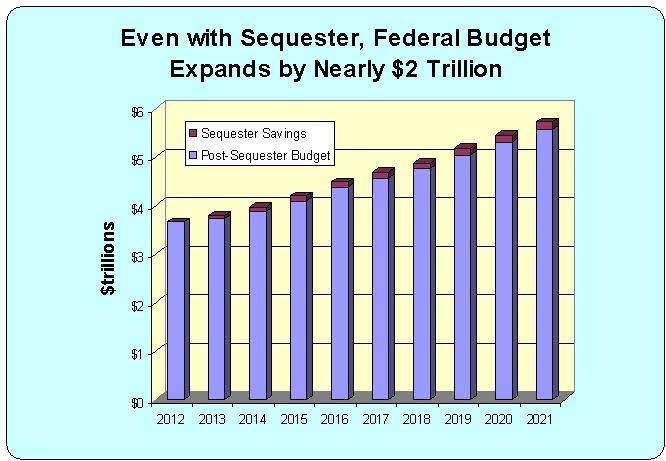
We’ve actually been down this path before. There was a small sequester back in the mid-1980s, shortly after the Gramm-Rudman-Hollings law was enacted. There was much wailing and gnashing of teeth, but the sequestration helped restrain the growth of spending and helped bring about a record amount of deficit reduction in 1987.
There was a similar (unsuccessful) fight in 1989. Here’s what then-Senator Bob Packwood of Oregon wrote in 1989.
…the sequester has become the focus of partisan debate . Each side accuses the other of being responsible for “deep and arbitrary” budget cuts . Some legislators say we should do whatever it takes to cancel the sequester, even if it means higher taxes. While a sequester is certainly not the ideal way to resolve this year’s budget dispute, there are reasons to believe that the fiscal discipline of a sequester is the medicine we need to cure the budget process. For all its drawbacks, a sequester is real deficit reduction . Instead of budget gimmicks, accounting tricks, phony cuts, and “revenue enhancements,” a sequester would reduce spending levels by a fixed percentage in eligible spending programs . In other words, unlike most deficit reduction packages, sequestration would actually reduce the deficit.
The only argument against a sequester, at least among conservatives, is that a sequester would impose too much of a burden on the defense budget. But I’ve already explained in this post that the defense budget will climb by about $100 billion under sequestration.
I don’t know whether Republicans are the stupid party, but I know they will be very stupid if they don’t take the sequester and declare victory.
 International Liberty
[…] From the irreplaceable Dan Mitchell: […]
[…] Spending was growing slower than the private economy, thanks in part to the Gramm-Rudman law that indirectly limited the growth of spending. […]
[…] And we may even lose the sequester, the provision that was included in the 2011 debt limit that would have slightly reduced the growth of government over the next 10 years. […]
[…] tell us that the money will be used to reduce the deficit, but at the same time they want to cancel the sequester, thus eliminating the only source of spending restraint from the 2011 debt-limit […]
[…] And we may even lose the sequester, the provision that was included in the 2011 debt limit that would have slightly reduced the growth of government over the next 10 years. […]
[…] The looters and moochers in Washington are increasingly agitated by the prospect of sequestration. […]
[…] The looters and moochers in Washington are increasingly agitated by the prospect of sequestration. […]
[…] In reality, the sequester merely means a reduction in the growth of federal spending. Even if we have the sequester, the burden of government spending will still be about $2 trillion higher in 10 years. […]
[…] And we may even lose the sequester, the provision that was included in the 2011 debt limit that would have slightly reduced the growth of government over the next 10 years. […]
[…] guys (and gals!) are calling for will not even make a dent in the deficit, let alone the debt. The “draconian cuts” are a joke and are not the issue, or the problem, […]
[…] actually will fall off two fiscal cliffs in January, but only one of them is bad. The good fiscal cliff is the so-called sequester, which is the inside-the-beltway term for automatic spending cuts. These aren’t really […]
[…] tell us that the money will be used to reduce the deficit, but at the same time they want to cancel the sequester, thus eliminating the only source of spending restraint from the 2011 debt-limit […]
[…] tell us that the money will be used to reduce the deficit, but at the same time they want to cancel the sequester, thus eliminating the only source of spending restraint from the 2011 debt-limit […]
[…] actually will fall off two fiscal cliffs in January, but only one of them is bad. The good fiscal cliff is the so-called sequester, which is the inside-the-beltway term for automatic spending cuts. …anything that restrains […]
[…] actually will fall off two fiscal cliffs in January, but only one of them is bad. The good fiscal cliff is the so-called sequester, which is the inside-the-beltway term for automatic spending cuts. These aren’t really […]
[…] are now sounding like born-again Keynesians. They object to the automatic budget savings – known as sequestration – that are scheduled to take effect next year, and they are warning that less government […]
[…] I like sequestration. Automatic budget cuts might not be the best way of reducing the burden of government spending, but a sequester is better than leaving the federal budget on autopilot. […]
[…] trillion increase in the borrowing limit, the largest such hike in the nation’s history, was a slight reduction in the growth rate of spending via sequestration — which Congress is busy crafting legislation to overturn — and the ill-fated Supercommittee […]
[…] $2.1 trillion increase in the borrowing limit, the largest such hike in the nation’s history, was a slight reduction in the growth rate of spending via sequestration — which Congress is busy crafting legislation to overturn — and the ill-fated Supercommittee […]
[…] be right if they’re predicting politicians are too irresponsible and profligate to accept about $100 billion of annual reductions from a $4,000 billion-plus budget, but that underscores the core message that there needs to be a cap on total spending so that the […]
[…] be right if they’re predicting politicians are too irresponsible and profligate to accept about $100 billion of annual reductions from a $4,000 billion-plus budget, but that underscores the core message that there needs to be a […]
[…] right if they’re predicting politicians are too irresponsible and profligate to accept about $100 billion of annual reductions from a $4,000 billion-plus budget, but that underscores the core message that there needs to be a cap on total spending so that the […]
[…] right if they’re predicting politicians are too irresponsible and profligate to accept about $100 billion of annual reductions from a $4,000 billion-plus budget, but that underscores the core message that there needs to be a cap on total spending so that the […]
[…] o The sequester is a good outcome. […]
[…] From the irreplaceable Dan Mitchell: They tell as that a sequester would mean “savage” and “draconian” budget cuts. The only “responsible” approach, we are told, is to go along with a tax increase. […]
[…] analysis of how the Bush-Obama spending binge worsened America’s fiscal situation, I think this chart from a previous post says it all (click to […]
[…] of how the Bush-Obama spending binge worsened America’s fiscal situation, I think this chart from a previous post says it […]
[…] is nonsense. As I’ve already explained, a sequester simply means that spending climbs by $2 trillion between now and 2021 rather than […]
[…] Washington. For American taxpayers, however, the only good conclusion is a Supercommittee deadlock, followed by a sequester. Rate this: Share this:PrintEmailFacebookTwitterMoredeliciousDiggFarkLinkedInRedditStumbleUponLike […]
[…] Republicans have complete power to achieve a victory in this battle. All that’s needed is for them to say no to a tax hike. That will lead to a Supercommittee stalemate, which will then lead to automatic budget savings known as sequestration. […]
Power corrupts.
AKA _years of having no consequences for ones actions is addictive and principles are lost track of.
After a media that hates their guts publically flogs them, they’ll fold. I’m not sure if that’s “stupid”, per se, but it will be spineless.